Sunday, May 15, 2011

Flick of The Day: We Own The Night

Taking its title from the motto of the NYPD Street Crimes Unit, the now disbanded unit legendary for its no holds barred attempts to clean up the streets of New York as it descended into nightmarish levels of crime in the 1980's, James Gray's film is steeped in nostalgia for an era when the City was not the wholesome tourist destination it is now. This is something which has been documented before in the likes of Scorsese's Bringing Out The Dead and the work of Abel Ferrara with films like King of New York and Bad Lieutenant.
Set against the backdrop of the ongoing and bloody war between the NYPD and the Russian mafia in 1980's Brooklyn and Brighton Beach, where Bobby Green, ably played by Joaquin Phoenix is manager of the hottest night club in town, which he manages on behalf of a Russian mafia front, unbeknownst of course. Bobby has a secret known only to his girlfriend, played by Eva Mendes, he comes from a family of cops. His father Bert, Robert Duvall in patriarch mode, is the deputy chief while his brother Joseph, a surprisingly good Mark Wahlberg, is a rising star. Together, Bert and Joseph are engaged in an investigation of the Russian gangsters who control the drug trade in the area. They attempt to reach out to Bobby, who blind to the actions of his Russian friends rebuffs them. It is only when the war on the streets begins to hit home that Bobby is forced to try and bring an end to the carnage that has engulfed the city.
The real strength of this film is the atmosphere and look that director James Gray has created. He seems to have a great feel for the material and there is much to enjoy in terms of the sights and sounds of 1980's New York from the music in Bobby's Club to the dark gritty violence that pervades the film, it pulls the viewer into the period and retains interest while the at times dense plot develops. It is helpful of course that all of the leads are in fine form, with Pheonix character having to carry much of the film as he transforms from a morally bankrupt Club manager to a crusading cop. A hefty transformation for any film to carry. The other saving grace of the film is a nuanced script with some memorable lines.


Joseph Grusinsky: I don't need any more guns in my life, that's for sure. But you should have one to be safe. It's better to be judged by twelve than carried by six.


Coming in at just under two hours, the film doesn't feel overly long and given the weighty storyline involved could easily have become a chore with a more indulgent director.That said, it is sombre in tone and those expecting constant action will be disappointed, with the plot playing out over the course of a year, giving it a more realistic feel.
All in all, this is a decent look at a very interesting period of recent history and anyone with a passing interest will find much to enjoy. The leads excel in what are at times stock roles with particularly fine turns from Joaquin Phoenix and Eva Mendes. Well worth a look.

Tuesday, May 10, 2011

Flick of The Day: Farewell / L'affaire Farewell

From acclaimed French director Christian Carion comes this beautiful little tale from the depths of the cold war, based on a real life spy story that ended with tragic consequences, today's flick of the day is Farewell.
Sergei Gregoriev is a high ranking KGB analyst in 1981 Moscow, wonderfully played by the Serbian film director Emir Kusturica. Sergei is dissatisfied with the Communist system and the cronyism of its leader Brezhnev and in an attempt to finally take down the regime, he decides to begin leaking information of the most sensitive kind to the West. His contact of choice? A young French businessman working in Moscow, Pierre Froment played by the director Canet. Making contact and gradually befriending Pierre, Sergei passes secrets which Pierre passes to French Intelligence and ultimately to Presidents Francois Mitterand and Ronald Reagan. The secrets were so valuable that it could only be seen at the highest level. Motivated only by ideology, Sergei only asks for some Queen tapes for his rebellious young son and a Sony Walkman. Of course as the stakes get higher, it becomes harder and harder for the two men to remain undetected as they pushed to breaking point. Like all the best espionage tales, this has a thrilling though poignant conclusion and asks questions of the lengths individuals will go for freedom.
The film is highly atmospheric, capturing the look and style of life under the Soviet system in the early 80's with some beautiful camera work of the city. The story it tells is a highly compelling one, so implausible it is amazing to find it a true story. Indeed, it is highly entertaining to see the extent to which the Russians has wormed their way into the heart of the American government. This is not your typical spy movie then, it is much more in the style of a John Le Carre thriller, with a lot of emphasis on the atmospherics and the minute details with less emphasis on action. The ending when it comes is not unexpected though sad all the same.
The regular references to the passing of intelligence between Reagan and Mitterand is useful, it lets you know how big an operation this was. Reagan is ably played by Fred Ward, while their is an icy turn from Willem Dafoe as the Head of the CIA. In reality the actions of Sergei did have the desired effect. His intelligence led to the destruction of the Soviet spy network in the US, and when Reagan announced his "Star Wars" initiative, the Soviets were in the blind and it forced Gorbachev to come to the Reykjavík Summit with no inside information and begin negotiations that eventually culminated in the Intermediate-Range Nuclear Forces Treaty a year later.
A very enjoyable film and an important story at the same time. It was because of the efforts of men like Sergei that the Cold War came to a conclusion, with the threat of Nuclear annihilation no longer hanging over the people of the world. Well worth a look.


Monday, May 9, 2011

Flick of The Day: Touch of Evil

Orson Welles is one of the great figures of Hollywood cinema. A child prodigy, he created a masterpiece with his feature debut, Citizen Kane, aged just 26. There is a certain revisionist view in vogue at the moment, which attempts to lessen the importance of the film, but it is so wrong. Even the most myopic of modern viewers can see how far ahead of its time it was in style, narrative structure and technique. However, Kane was a commercial failure and a controversial one at that. Thereafter, Welles was never given the chance to make a film in Hollywood without interference, and never lived up to the early promise of his debut. However the closest he came was today's flick of the day, Touch of Evil.
After a long period in the wilderness, Welles was hired to play the role of Captain Quinlan, a corrupt local police captain in a town on the American side of the Mexican border. As was often the case, he was soon directing and writing the feature, largely at the behest of star Charlton Heston. The film opens with a much imitated and lauded tracking shot in a rough and tumble Mexican border town, as a bomb is placed in the back of a car of a local businessman and his girlfriend. We follow the car as it moves to the border crossing, along the way we meet Mexican narcotics officer Ramon Vargas, played by Heston and his new bride Susan, played by Janet Leigh as they walk back to their Hotel on the American side. Just over the border, the bomb explodes in a fiery ball, killing the passengers. Of course, as the man on the spot, Vargas feels the need to get involved. Before long, Quinlan is on the scene and doesn't react well to Vargas' involvement. Together they investigate the crime, with Quinlan suspecting a local Mexican employee of the murdered man of planting the bomb. However he chooses to plant evidence on him rather then find proof, setting him on a collision course with Vargas. The film is classic noir, with an ending to match.
Welles is brilliant himself as the malevolent Quinlan, the big fish in the small pond used to getting his way all the time. As one of his former paramour's Tanya played Marlene Dietrich, puts it at the end of the film:

He was some kind of a man... What does it matter what you say about people?

While Heston is not believable as a Mexican, his straight laced approach to the role of the narcotics officer Vargas is well suited and he plays it well throughout. Janet Leigh isn't given a whole lot to do as his wife, apart from being set upon by a band of "marijuana fiends", in a scene that is funny in an unintended manner. 
The plot is no more then your average potboiler then, but it is made then the material by Welles direction. The opening tracking shot, which lasts nearly 3 and a half minutes is just one of a number of technically daring shots in the film and Welles assembled  a great supporting cast including cameo appearances from Zsa-Zsa Gabor and Joseph Cotten. Welles was always famous for his ability to work with actors, seeking their input which was something the likes of Janet Leigh has not experienced before:


"It started with rehearsals. We rehearsed two weeks prior to shooting, which was unusual. We rewrote most of the dialogue, all of us, which was also unusual, and Mr. Welles always wanted our input. It was a collective effort, and there was such a surge of participation, of creativity, of energy. You could feel the pulse growing as we rehearsed. You felt you were inventing something as you went along. Mr. Welles wanted to seize every moment. He didn't want one bland moment. He made you feel you were involved in a wonderful event that was happening before your eyes."


The film should have gone on to great critical acclaim, however when Welles presented his cut to Univeral Internation Pictures, they took the film away from and re-shot and edited it to the point where the plot was incomprehensible and robbed it of the style and wit he had wanted. It was released as a B movie and it largely disappeared from view thereafter until in 1998, the film was re-edited as per Welles wishes and released again on DVD where it found the audience it deserved.


Ultimately Welles never made another film for a major studio, and his relationship with Hollywood was frosty in general. Viewed today, it is a fine film, an entertaining story which is driven by strong performances from Welles and Heston. While not a masterpiece, it is a fine example of the talent of Orson Welles as a director, producing a silk purse of a film out of a sows ear of a b-movie story. Oh, what might have been...

Sunday, May 8, 2011

Flick of The Day: The Player

Of all the talented directors to make their name in the rush to modernity that was 1960's and 70's cinema, perhaps the one most willing to go against the grain was Robert Altman. After a substantial career in television and documentaries stretching back to the late '40s, he made his name with 1969's M*A*S*H which got him recognised as major talent at the same time as a band of much younger filmmakers like Friedkin, Coppolla, and Scorsese broke through. Always one to buck against the system, he was more loved by critics then by audiences and after the failure of his adaptation of Popeye in 1980, he largely disappeared from the Hollywood mainstream and by the time of today's flick of the day in 1992, The Player, he had not made a studio picture in 8 years.
A biting satire of the Hollywood system and the ethics of the film industry in general, The Player is Altman biting back at the hand that fed him. Remembered mainly for its legions of cameos from some of the biggest name in Hollywood, the film centres on a studio executive called Griffin Mill, played by a delightfully slimy Tim Robbins. Mill is receiving death threats from a disgruntled writer for whom he has committed the grievous sin of promising to call him back and never doing so. As the threats escalate, Mill decides to take things into his own hands and try and find out who the mystery writer is he has irked, there are so many possibilities. Another threat to Mill's comfortable lifestyle is the rising star executive, Larry Levy, who Griffin will have to outmanoeuvre to stay at the top. Eventually Mill tracks down a writer in Pasadena who he suspects of holding a grudge. He attempts to buy off the writer with a promise of deal, but of course he has the wrong writer. They quarrel in a car park and in a rage, Mill murders him and flees the scene. As Mill attempts to avoid the suspicions of the local police led by Whoopi Goldberg, he is also attempting to rid himself of his rival Levy by landing him with a terrible movie idea from writer Richard E Grant in a brilliant turn. He is also pursuing the dead writer's girlfriend. Ultimately, events lead to a brilliantly scabrous conclusions as Griffin Mill outdoes everyone.
Altman manages to both skewer Hollywood and endear himself to the insiders judging by the legion of actors, writers and directors that lined up to make cameos in the film including A-listers like Bruce Willis and Julia Roberts. Half the fun of the film is spotting the various people who pop in and out of the rich canvas Altman creates. The film is a vicious attack on all the calling cards of the Hollywood system; Violence, Sex, Mean Spirited Humour and Happy Endings. Yet it mocks them all by containing plenty of each with a happy ending that benefits the wrong man and ironically was a big commercial success accordingly.

Griffin Mill: It lacked certain elements that we need to market a film successfully. 
June: What elements? 
Griffin Mill: Suspense, laughter, violence. Hope, heart, nudity, sex. Happy endings. Mainly happy endings. 
June: What about reality?

It helps of course that the characterizations are so knowingly well drawn. Tim Robbins manages to be just as slimy as you imagine the average studio executive to be. The various celebrities play up to their image as either airheads or having equal contempt for the likes of Griffin Mill as the audience does. 
Altman has created a fantastic film here, managing to both entertaining and a biting attack on the Hollywood system which he had grown to detest after years of watching his films butchered before release. Tim Robbins carries the film completely as an amoral cad bent on power at all costs. It is also technically strong, with an opening sequence shot lasting nearly 8 minutes without a single camera break in a homage to Welles' Touch of Evil and Hitchcock's Rope, which are both referenced by characters in that scene. A very fine film which reminded audiences of the natural talent of Robert Altman. Well worth seeking out.

Thursday, May 5, 2011

Flick of The Day: Persepolis

I often feel like I am banging a drum, repeating a point of view in films of a similar theme, so do forgive me if this seems repetitious. A couple of weeks back, we looked at Waltz With Bashir, noting how it showed the power of animation to tell important stories that would otherwise not be possible without a vast Hollywood budget. Today's flick of the day, Persepolis is a similarly powerful story told in an artful manner.
Based on the best selling autobiographical graphic novel of the same name by Marjane Satrapi, Persepolis is the tale of a childhood lived under the fundamentalist regime of the Iranian Ayatollahs. Opening with Marjane sitting in the departure lounge of a Paris airport pondering her life, before we see her as 9 year old living in Tehran in 1978, a Bruce Lee fan that dreams of being a prophet. Adored by her grandmother, voice by Catherine Deneuve, Marjane has a unique view of the world around her and is at heart a free spirit. Of course with the fall of the Shah in 1979 and the rise of a religiously strict and intolerant regime, her world is thrown upside down. Marjane, being a teenager rebels against the rigid control of life under the Ayatollahs, listening to Heavy Metal and Punk, wearing denim and openly questioning the lies of her teachers as they cover up for the abuses of the State. Fearing for her safety and hoping to give her freedom to express herself, she is sent to a boarding school in Vienna in 1983. Of course Catholic nuns have never been known for their freedom of expression and Marjane finds herself once again railing against the system. After a series of events, Marjane finds herself sleeping rough for a few months before returning to Tehran in 1987. She attempts to live under the regime, attending University and eventually marrying, but her political dissent in a country where mass executions for political beliefs and petty religious absurdities have become common  place. Ultimately Marjane is forced to leave Iran, perhaps forever but it will always remains in her heart.
Although the film is for the most part shot in a stark black and white animation, it never feels weighed down or depressing despite dealing with subject matter far beyond anything dealt with in your average American animated film. This is perhaps because the animation is warm and familiar, however the use of black and white does give the film an air of oppression throughout. This air wonderfully recreates what life must have been like for a young girl trying to find her feet under a totalitarian regime. The film only takes on colour in the prologue and epilogue, the rest is shot through with this oppressive black and white, tellingly including the Vienna scenes.  This could become tiresome quite quickly and make the film unwatchable given the subject matter however it is saved by two things, stunningly beautiful visual invention and great storytelling. It is playful and beauty is found in even the darkest of scenes. The storytelling aspect is that humour is used throughout to leaven proceedings.

I remember I led a peaceful, uneventful life as a little girl. I loved fries with ketchup, Bruce Lee was my hero, I wore Adidas sneakers and had two obsessions: Shaving my legs one day and being the last prophet of the galaxy.

This is what film making is supposed to be about and anyone willing to get past the idea that animation is for entertaining young children and should thus be easily enjoyed, will find much to enjoy here. It is also a must see for anyone with even a passing interest in middle eastern history of the late 20th Century.

Wednesday, May 4, 2011

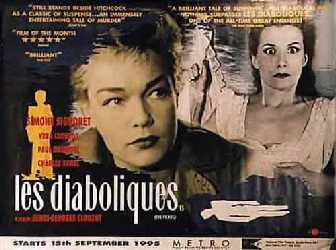
Flick of The Day: Les Diaboliques / The Devils

A few weeks back we looked at Henri-Georges Clouzot's work, The Wages of Fear, noting his reputation as the French Hitchcock. Today's flick of the day is perhaps his masterpiece, Les Diaboliques, a devilish psychological thriller set in a boarding school. 
In a provincial boarding school run by the brutish Michel Delassalle played by Paul Meurisse, his long suffering wife Christina and his equally downtrodden mistress Nicole are plotting murder. Though Christina owns the boarding school of which he is headmaster, she has been beaten down by years of abuse and suffers from a weak heart. Together they draw up a plan to get rid of him over a holiday weekend. Christina runs away with Nicole to her country home and telephones Michel to demand a divorce. Michel pursues the pair and when he arrives, Christina drugs him with tainted whiskey and together they drown him in a bathtub. Hiding the body in a wicker basket, they return to the school late at night and dump Michel into the murky depths of the pool. Of course, like all best laid plans, something goes wrong. A series of events point to Michel being very much alive and when they drain the pool, his body is nowhere to be found.  Is he alive or dead? Christina can not handle the guilt and with her heart troubling her takes to her bed. However all is not as it seems and Les Diaboliques has one of the great twist endings of all time.
This is a real gem of a film and Clouzot successfully builds the tension as the plot unfolds and Christina's mind begins to unravel. He does this by creating a chilling atmosphere in the school, with pupils swearing they saw the missing headmaster and lots of atmospheric dark corners with doors opening unbidden in the night. All very much the kind of tactics used in your average horror film. This leads the audience to begin to question what they are seeing, much like Christina. Until the last frame, you are unsure as to Michel's ultimate fate and that is a remarkable achievement. There is also some some excellent symbolic imagery. When a guilty Christina hires a retired detective to investigate Michel's disappearance, there is a scene where they talk in the bedroom partitioned by bars much like a murder suspect behind bars.
It is difficult to overestimate the significance of this film with its plot lines and twists turning up in various forms in numerous thrillers down through the years. Indeed the film itself has been remade three times including a truly dire Sharon Stone vehicle from the '90s remarkable only for abandoning Clouzot's ending and reproducing the rest of the film shot for shot. I suppose it has always been thus in Hollywood.

Christina Delassalle: So it's a coincidence? 
Nicole Horner: A coincidence, yes. 
Christina Delassalle: And Fichet. Was his being at the morgue a coincidence? And the suit. And the hotel. And now the children! Is it a coincidence that it's getting closer and closer?

A great film which any self-respecting thriller fan has to see, it has become a touchstone for the genre since its release in 1955. Perhaps Clouzot's best work alongside The Wages of Fear, it marked  him as director par excellence. The film still feels fresh today with its plot riddled with turns, sexual intrigue and a story that any audience can find compelling and believable.

Tuesday, May 3, 2011

Flick of The Day: Munich

Steven Spielberg has attempted historic epics before with film's like Schindler's List and Saving Private Ryan but rarely has he examined an issue without voicing a point of view on an event. With today's flick of the day, Munich, Spielberg does exactly that, neither questioning the reasoning behind the Israeli actions nor portraying the Palestinians as heartless, faceless evildoers. It is a meditation on the effects of seeking revenge and of the moral consequences of doing so.
Produced in the same year as Spielberg's blockbuster remake of War of the Worlds, much as he had done in 1993 with Jurassic Park and Schindlers List, Munich is a sombre thriller if such a thing is possible. Opening with a meticulous recreation of the events that occurred at the Munich Olympics in September 1972, while this has been done before in Kevin Macdonald's excellent documentary One Day in September, it is still well done. The use of news footage is particularly striking, given that it was sports reporters covering the Olympic Games which largely documented the hostage situation. After the massacre unfolds and the death of the Black September terrorists, largely due to a botched German rescue attempt, the film outlines the resolution of the Israeli government under Golda Meir to track down and kill those responsible. Mossad agent Avner, played by Eric Bana with a ruthless intensity, is recruited by Geoffrey Rush to lead the team. The team chosen are interestingly not professional assassins, but ordinary Israelis with military training and the kind of special skills required for the job including Daniel Craig and Ciaran Hinds. Both excel in their roles, each character given a background to work with. The fact that they are for want of a better word, normal, is what makes this film interesting. How they deal with the effects of having to devote their lives to seeking revenge and of having to do the actual killing is what drives much of the film. Each deals with it differently but as the story unfolds, it weighs on them all.
Coming in at just under 3 hours in length, the film feels over-long at times but then as Avner and co jump from locale to locale, taking out their targets along the way, it is thrilling and largely holds your attention. Perhaps the most interesting aspect of the film is that Spielberg seems to take the opinion that both the Palestinian terrorists and the Mossad assassins are morally equivalent or at the very least offers this for our decision. In one entertaining scene, the undercover agents enter a safe house they have hired only to find it double booked by a group of Palestinians. Pretending to be fellow revolutionaries, they fall into conversation and Avner and their leader discuss the wishes of the Palestinian cause. I suppose ultimately the question at the heart of the film is whether it is right or not for a State to seek revenge in the form of an eye for an eye?

Ephraim: We have 11 Palestinian names. Each had a hand in planning Munich. You're going to kill them, 11 men, one by one. They're all in Europe now. You'll stay there as long as it takes. Europe only, not the Arab countries. That's for us, not you. And not Eastern Bloc. Don't upset the Russians. Who needs it? You'll have no contact with us. 
Avner: You're not going to give me any information? 
Ephraim: We deposit money from a fund that doesn't exist into a box we don't know about, in a bank we never set foot in. We can't help you because we never heard of you before. You'll do what the terrorists do. You think they report back to home base? They don't. We want them dead.

By posing this question, Spielberg is very much asking the audience to look at the events of today, where for the past decade the US government has pursued the planners of 9/11 in just such a manner as the Israelis. If the events of the past days have been proof of anything, it is that America has been as equally as effective as Israel in this quest for retribution.
The film is not without its flaws, in one of the closing scenes, flashback footage of the massacre is inter-cut with Avner making love to his wife implying that he is haunted and seeking solace in his wife. However, given that the footage is not news footage and bare in mind that Avner was never at Munich, what are we to draw from this? How could he be so haunted by imagery he never saw?

Avner: If these people committed crimes we should have arrested them. Like Eichmann. 
Ephraim: If these guys live, Israelis die. Whatever doubts you have Avner, you know this is true. 
[Avner walks away] 
Ephraim: You did well but you're unhappy. 
Avner: I killed seven men. 
Ephraim: Not Salameh. We'll get him of course.

In the end, this is a satisfying and beautifully shot examination of the after effects of the Black September massacre. Dealing with complex and dense issues, it makes for an entertaining if at times slow film. It also never comes to a resolution of the question it poses about the morality of state-sponsored revenge. Well worth a look.