A few weeks back we looked at Henri-Georges Clouzot's work, The Wages of Fear, noting his reputation as the French Hitchcock. Today's flick of the day is perhaps his masterpiece, Les Diaboliques , a devilish psychological thriller set in a boarding school.
, a devilish psychological thriller set in a boarding school. 
In a provincial boarding school run by the brutish Michel Delassalle played by Paul Meurisse, his long suffering wife Christina and his equally downtrodden mistress Nicole are plotting murder. Though Christina owns the boarding school of which he is headmaster, she has been beaten down by years of abuse and suffers from a weak heart. Together they draw up a plan to get rid of him over a holiday weekend. Christina runs away with Nicole to her country home and telephones Michel to demand a divorce. Michel pursues the pair and when he arrives, Christina drugs him with tainted whiskey and together they drown him in a bathtub. Hiding the body in a wicker basket, they return to the school late at night and dump Michel into the murky depths of the pool. Of course, like all best laid plans, something goes wrong. A series of events point to Michel being very much alive and when they drain the pool, his body is nowhere to be found. Is he alive or dead? Christina can not handle the guilt and with her heart troubling her takes to her bed. However all is not as it seems and Les Diaboliques has one of the great twist endings of all time.
has one of the great twist endings of all time.
This is a real gem of a film and Clouzot successfully builds the tension as the plot unfolds and Christina's mind begins to unravel. He does this by creating a chilling atmosphere in the school, with pupils swearing they saw the missing headmaster and lots of atmospheric dark corners with doors opening unbidden in the night. All very much the kind of tactics used in your average horror film. This leads the audience to begin to question what they are seeing, much like Christina. Until the last frame, you are unsure as to Michel's ultimate fate and that is a remarkable achievement. There is also some some excellent symbolic imagery. When a guilty Christina hires a retired detective to investigate Michel's disappearance, there is a scene where they talk in the bedroom partitioned by bars much like a murder suspect behind bars.

It is difficult to overestimate the significance of this film with its plot lines and twists turning up in various forms in numerous thrillers down through the years. Indeed the film itself has been remade three times including a truly dire Sharon Stone vehicle from the '90s remarkable only for abandoning Clouzot's ending and reproducing the rest of the film shot for shot. I suppose it has always been thus in Hollywood.
Christina Delassalle: So it's a coincidence?
Nicole Horner: A coincidence, yes.
Christina Delassalle: And Fichet. Was his being at the morgue a coincidence? And the suit. And the hotel. And now the children! Is it a coincidence that it's getting closer and closer?
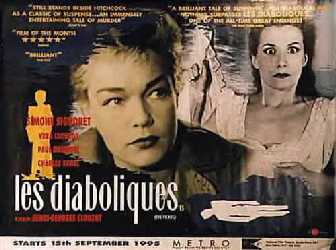
A great film which any self-respecting thriller fan has to see, it has become a touchstone for the genre since its release in 1955. Perhaps Clouzot's best work alongside The Wages of Fear, it marked him as director par excellence. The film still feels fresh today with its plot riddled with turns, sexual intrigue and a story that any audience can find compelling and believable.

 and today's flick of the day,
  , Clouzot established himself internationally as a director of thrillers par excellence.


 . The film was a flop for one very obvious reason, it's rather glaringly inappropriate title. Fans of Friedkin's
  were undoubtedly disappointed not to find a single Sorcerer on display. The original is by far the better of the two film's, anchored by a fine performance from