Showing posts with label noir. Show all posts

Sunday, January 8, 2012

Flick of The Day: Sweet Smell of Success

It is a well known truth that sometimes greatness is isn't immediately seen. So often in life, it is only with a second view that people see real talent and true achievement. Cinema is no different. Everyone can think of a film that was a failure upon its release only to be reappraised later, The Shawshank Redemption, Withnail & I and Kingdom of Heaven are obvious examples. Today's flick of the day, Sweet Smell of Success is another. One of the great noir pictures of the 1950's, it was an ignominious failure on release but over the years has come to be seen for what it is, a classic plain and simple.
Tony Curtis is a grasping and oily young press agent named Sydney Falco, a man who spends his nights listening,cajoling and schmoozing in the New York night scene on behalf of his clients. His business lives and dies by the items of gossip and innuendo he can place with the various newspaper columnists who can destroy a career with a single column and make it with an another. Sydney has fallen foul of the most powerful of them all, J.J. Hunsecker played by a brilliant Burt Lancaster. Hunsecker wields his power like a weapon, using it to beat down anyone who crosses him. This now includes Sydney who J.J. had inveigled into attempting to break up the relationship between J.J's sister and an up and coming jazz musician without success. He gives Falco a second chance but asks him to plant marijuana on the musician. How low is Falco prepared to go to please the malignant Hunsecker?
Lancaster is deliciously evil as the columnist without any scruples. One of the all time great cinema villains, the character was modelled on the powerful columnist Walter Winchell which drew his ire and garnered the film unfavourable reviews on its release. Hunsecker is dark and right wing and willing to go to any lengths to get what he wants. The dialogue sparks in short, staccato sentences with some great put downs.

J.J. Hunsecker: Mr. Falco, let it be said at once, is a man of 40 faces, not one - none too pretty, and all deceptive. You see that grin? That's the, eh, that's the Charming Street Urchin face. It's part of his helpless act: he throws himself upon your mercy. He's got a half-dozen faces for the ladies. But the one I like, the really cute one, is the quick, dependable chap. Nothing he won't do for you in a pinch - so he says. Mr. Falco, whom I did not invite to sit at this table tonight, is a hungry press agent, and fully up to all the tricks of his very slimy trade.

The back and forth between the two morally corrupt characters of Curtis and Lancaster is a joy to watch. The other star of the show is of course the shadows and light which colour the city at night. From the glitz and neon of the nightclubs and Broadway to the dimly lit after hours bars.
One of the last great New York noirs, the black and white photography is perfectly suited to the mood of the film which is decidedly downbeat and pessimistic. Hunsecker is not brought low despite his actions though Sydney does partially redeem himself by doing the right thing, proving that their are depths to which even a press agent will not sink.

J.J. Hunsecker: Harvey, I often wish I were dead and wore a hearing aid. With a simple flick of a switch, I could shut out the greedy murmur of little men.

A great dialogue driven script, a fine cast and an Elmer Bernstein score matched with stunning visuals of the city that never sleeps, this is a film that you really have to see. Directed with precision by British director Alexander Mackendrick who had already had quite a career making Ealing comedies like Whisky Galore! and The Ladykillers, this is an underrated film which has become even more relevant as the years go by foreshadowing the degeneration of the American newsmedia.


Monday, September 26, 2011

Flick of The Day: Kiss Kiss, Bang Bang

The life of the screenwriter is often lamented as being the bottom rung on the Hollywood ladder, with numerous anecdotes down through the years of how they have had their work destroyed by the studios and incompetent executives. This is perhaps overplayed though and as the industry has developed they have become as much a part of the system as anything else. Perhaps the career of Shane Black is an example of this, writing his first script in six weeks aged 23, his agent would sell Lethal Weapon in 3 days for $250,000. Black would go on to write some of the biggest action pictures of the era such as The Last Boy Scout and The Long Kiss Goodnight for ever increasing sums. Then he seemed to disappear off the radar for a few years before returning with today's flick of the day which he wrote and directed, the wonderful post modern noir Kiss Kiss, Bang Bang.
Robert Downey Jr is Harry Lockhart a down on his luck thief in New York City who while attempting to escape from the police, happens upon an open audition for a Hollywood film. Impressing the producer with his, "old school method" acting he is soon whisked out to Los Angeles for a screen test. Acting as an inconsistent and at time satirical narrator of his own story, Downey Jr is excellent as Harry. The film opens as Harry arrives at a party in the Hollywood hills, we are soon introduced to an old flame from his youth and aspiring actress Harmony, played by the beautiful Michelle Monaghan and Private Eye Gay Perry who is to give Harry detective lessons. Val Kilmer thoroughly enjoys his role as the tough homosexual Perry. Together they stumble across a plot to murder an heiress and frame Harry for it. 
The real strength of Black's directorial début is the concentration on characterisation with strong turns from Downey Jr and a great ensemble cast. This is combined with a strong mystery story that steals from some of the greats of the genre like Chandler and Hammet. The plotting never feels too dense and is compelling until the final scene. It helps of course that the script is at times quite funny and self referential. Downey's Harry is a narrator who is forever mocking the different conventions of the genre while finding fun in the least obvious places. At one point, Harry says

                  "Don't worry, I saw Lord of the Rings. I'm not going to end this 17 times"

There are some great quotable lines, many of which are for Val Kilmer as the flamboyant Gay Perry who combines his role as the (non) straight guy with a dry wit.
While it is slick and very aware of its place as a genre film, it is still and entertaining piece of action comedy. So much of the current releases are so terribly po faced and this is a refreshing change.

Perry: You don't get it, do you? This isn't "good cop, bad cop." This is fag and New Yorker. You're in a lot of trouble.

While Robert Downey Jr has since gone on to be as big a star as he ever was, it is worth remembering that this was one of the first tentative steps back on to the big screen after his much publicised addictions. It showed how good an actor he could be, which should never have been in doubt.
All in all, a fine film which makes the best of the talents at its disposal. Downey Jr would go on to be one of the biggest stars in the world at the moment and Kilmer would enjoy a revival as a character actor. While Shane Black has largely directed music videos since this, he has recently been signed on to direct the third instalment of the Iron Man franchise, starring of course Robert Downey Jr. Well worth your time.

Monday, June 27, 2011

Flick of The Day: Chinatown

So here we are, my favourite film of all time. Perfection is a strong word but in terms of cinema, today's flick of the day is as close to  perfection as is possible in a full length feature in the modern era. A towering central performance, a director on top form and a legendary screenwriter, this film is the sum of its parts. A dark and disturbing journey into life and corruption in sun drenched 1930's Los Angeles. Forget it Jake, It's Chinatown.
Jake Gittes, a superb Jack Nicholson, is a private eye who specialises in catching out cheating spouses. A former cop, he has a sharp eye and a quick tongue. One day he is hired by Evelyn Mulwray to follow her husband Holles, whom she suspects of infidelity. Holles is Chief Engineer in the Water department. As Jake follows Holles around, he is intrigued to find him taking unexplained trips to various reservoirs and water tables. However, when he photographs Holles in the company of a young girl, he figures his job is done. However it quickly becomes apparent that Jake is in over his head when the real Mrs Mulwray, played by Faye Dunaway turns up and had nothing to do with hiring Jake and Holles turns up dead. Going against his own gut, he decides he has to get to the bottom of a tangled web involving shady land deals, corrupt bureaucracy, orange farmers and Evelyn's father, an ageing land baron called Noah Cross, played by the incomparable John Huston. A dark and shocking finale ensues, in which Jake is forced to fight against forces he is powerless to stop and has to confront his own past in Chinatown.
A powerful film even today, the real crux of its success is to marry the kind of classic screen noir of the 1930's and 40's with a pessimistic critique of capitalist and bureaucratic structures that began to seep into American cinema in the post Watergate 70's. A great script from Robert Towne marries these grand themes with a story of corruption and family deceit that is as old as Oedipus. It is packed with great quotable lines.

Jake Gittes: Mulvihill! What are you doing here? 
Mulvihill: They shut my water off. What's it to you? 
Jake Gittes: How'd you find out about it? You don't drink it; you don't take a bath in it... They wrote you a letter. But then you have to be able to read.

It would be a shame if this script were wasted on ropy acting and lazy direction. Thankfully, then these elements are equally strong. Nicholson gives a strong performance in a role that cemented his place as a star. Hollywood legend John Huston is equally adept as the malevolent Noah Crosss and his scenes with Nicholson are a treat. Roman Polanksi's direction is even paced and draws the best out of the cast and the script. Almost flawless.
The film was nominated for 11 Academy Awards on its release in 1974, winning just the one for Robert Towne's brilliant script having had the misfortune of being made in the same year as The Godfather Part II. It's reputation has only grown in the intervening years, becoming something of a mythic beast such is the reputation of the likes of Towne, Polanski and Nicholson in terms of the 70's New Hollywood movement. It even spawned a vastly inferior sequel in 1990, The Two Jakes.

Jake Gittes: In Chinatown. 
Evelyn Mulwray: What were you doing there? 
Jake Gittes: Working for the District Attorney. 
Evelyn Mulwray: Doing what? 
Jake Gittes: As little as possible. 
Evelyn Mulwray: The District Attorney gives his men advice like that? 
Jake Gittes: They do in Chinatown.

The film is relentlessly cynical in its outlook, something that is at the heart of film noir but in this case updated for a modern audience. This alone would have made the film memorable but the combination of this with a great story and the aforementioned talents of Nicholson et al raise this to another level.
Well, what else is there to say? This really is my favourite film of all time. It is as good as it gets on all fronts and really a must see for anyone with an interest in great cinema. Check it out.

Monday, May 9, 2011

Flick of The Day: Touch of Evil

Orson Welles is one of the great figures of Hollywood cinema. A child prodigy, he created a masterpiece with his feature debut, Citizen Kane, aged just 26. There is a certain revisionist view in vogue at the moment, which attempts to lessen the importance of the film, but it is so wrong. Even the most myopic of modern viewers can see how far ahead of its time it was in style, narrative structure and technique. However, Kane was a commercial failure and a controversial one at that. Thereafter, Welles was never given the chance to make a film in Hollywood without interference, and never lived up to the early promise of his debut. However the closest he came was today's flick of the day, Touch of Evil.
After a long period in the wilderness, Welles was hired to play the role of Captain Quinlan, a corrupt local police captain in a town on the American side of the Mexican border. As was often the case, he was soon directing and writing the feature, largely at the behest of star Charlton Heston. The film opens with a much imitated and lauded tracking shot in a rough and tumble Mexican border town, as a bomb is placed in the back of a car of a local businessman and his girlfriend. We follow the car as it moves to the border crossing, along the way we meet Mexican narcotics officer Ramon Vargas, played by Heston and his new bride Susan, played by Janet Leigh as they walk back to their Hotel on the American side. Just over the border, the bomb explodes in a fiery ball, killing the passengers. Of course, as the man on the spot, Vargas feels the need to get involved. Before long, Quinlan is on the scene and doesn't react well to Vargas' involvement. Together they investigate the crime, with Quinlan suspecting a local Mexican employee of the murdered man of planting the bomb. However he chooses to plant evidence on him rather then find proof, setting him on a collision course with Vargas. The film is classic noir, with an ending to match.
Welles is brilliant himself as the malevolent Quinlan, the big fish in the small pond used to getting his way all the time. As one of his former paramour's Tanya played Marlene Dietrich, puts it at the end of the film:

He was some kind of a man... What does it matter what you say about people?

While Heston is not believable as a Mexican, his straight laced approach to the role of the narcotics officer Vargas is well suited and he plays it well throughout. Janet Leigh isn't given a whole lot to do as his wife, apart from being set upon by a band of "marijuana fiends", in a scene that is funny in an unintended manner. 
The plot is no more then your average potboiler then, but it is made then the material by Welles direction. The opening tracking shot, which lasts nearly 3 and a half minutes is just one of a number of technically daring shots in the film and Welles assembled  a great supporting cast including cameo appearances from Zsa-Zsa Gabor and Joseph Cotten. Welles was always famous for his ability to work with actors, seeking their input which was something the likes of Janet Leigh has not experienced before:


"It started with rehearsals. We rehearsed two weeks prior to shooting, which was unusual. We rewrote most of the dialogue, all of us, which was also unusual, and Mr. Welles always wanted our input. It was a collective effort, and there was such a surge of participation, of creativity, of energy. You could feel the pulse growing as we rehearsed. You felt you were inventing something as you went along. Mr. Welles wanted to seize every moment. He didn't want one bland moment. He made you feel you were involved in a wonderful event that was happening before your eyes."


The film should have gone on to great critical acclaim, however when Welles presented his cut to Univeral Internation Pictures, they took the film away from and re-shot and edited it to the point where the plot was incomprehensible and robbed it of the style and wit he had wanted. It was released as a B movie and it largely disappeared from view thereafter until in 1998, the film was re-edited as per Welles wishes and released again on DVD where it found the audience it deserved.


Ultimately Welles never made another film for a major studio, and his relationship with Hollywood was frosty in general. Viewed today, it is a fine film, an entertaining story which is driven by strong performances from Welles and Heston. While not a masterpiece, it is a fine example of the talent of Orson Welles as a director, producing a silk purse of a film out of a sows ear of a b-movie story. Oh, what might have been...

Thursday, April 28, 2011

Flick of The Day: L.A Confidential

The work of American novelist James Ellroy is notoriously hard to adapt for the screen, written as it is in short staccato sentences with dense plotting involving numerous strands and characters. This is its strength as fiction but obviously harder to carry onto the big screen. If this in done badly, you get a flop like Brian De Palma's The Black Dahlia, if done well, you get today's flick of the day, L.A Confidential one of the best films of the 1990's and a multiple Oscar winner.
Apart from a great script from director Curtis Hanson and Brian Helgeland which successfully reduces the scope of Ellroy's novel while still retaining the core story, the other main strength of this movie is a cast to die for. Russell Crowe is a violent yet good hearted Detective Bud White, James Cromwell is his Machiavellian commanding officer, Captain Dudley Smith. Guy Pearce is Edmund Exeley an up and coming strait laced star of the LAPD. Kevin Spacey, is Hollywood Jack Vincennes, an amoral cop to the stars. Kim Basinger is Lynn Bracken, a high class call girl whose career is managed by millionaire Pierce Morehouse Patchett, a brilliant turn from David Strathairn and finally Danny DeVito as the sleazy magazine editor Sid Hudgens.
Set in 1950s Los Angeles, the film opens on Christmas Eve when a group of drunken detectives attack some newly apprehended suspects in an event the press dub, "Bloody Christmas". Thereafter in an attempt to clean up the force, the top brass seek to prosecute the officers involved. Keen to move up, Exeley agrees to testify against his own colleagues, making him a hated figure while Bud White and Jack Vincennes refuse. The film then follows the rise and fall of these three detectives and their boss, Captain Smith. They become embroiled in the investigation of a shocking massacre at a late night coffee shop that may or may not involve organised crime. However all is not as it seems, and  an intricate plot leads to a great twisting conclusion involving drugs, prostitution and police corruption that goes to the very top. 
With a plot dense enough to match the great of the genre like Chinatown or The Big Sleep, this is a great detective yarn. Hanson has managed to perfectly capture the glamour and sleazy underbelly of post-war Los Angeles. Down to a tee, everything feels perfectly of the period in terms of fashion, decor and location. It sucks you into the period and tells a great story.The film received 9 Oscar nominations but lost in almost all categories due to the unstoppable juggernaut that was Titanic. It is shocking now to think that a film as poorly written and acted as Titanic outshone this picture but such are the unknowing ways of the Academy. One of the few awards it did win was for its screenplay, adapted as I've said by Hanson and Helgeland which is well deserved as the film is endlessly quotable.
Bud White: Merry Christmas. 
Lynn Bracken: Merry Christmas to you, officer. 
Bud White: That obvious, huh? 
Lynn Bracken: It's practically stamped on your forehead

This really is a must see film, combining a great cast with a fine script to produce a really old-fashioned actor driven movie, the kind that studios either don't want to make or are unable of making. They seem more and more interested in producing thrash in a 3D glaze with each passing day. I am no luddite and have never been against the use of advancing technology in cinema but it should not be at at the expense of basic storytelling. It is telling that this film lost out to effects driven schlock like Titanic, telling and disappointing. A great film.

Wednesday, March 9, 2011

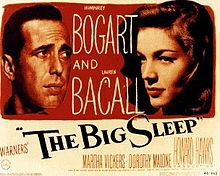
Flick of The Day: The Big Sleep (1946)

As noted during our look at The Maltese Falcon, Raymond Chandler is to detective fiction what Elvis Presley is to rock n roll. He is one of the most influential writers of his time and perhaps his greatest creation is Philip Marlowe. This adaptation is perhaps the most stylish and the least cogent. Today's film is The Big Sleep.
A star vehicle for Humphrey Bogart and Lauren Bacall who by this time were married and very much the biggest stars of the day. In fact, additional scenes between the two were added to highlight their chemistry. Directed by Howard Hawks, the film is famed for its convoluted plot, and it is hard at times to follow. The important point to remember though is that essentially the story as written by Chandler is about the process of an investigation and how the characters interact rather then catching the killer. It is perhaps best to just relax and allow the plot to flow over you. Legend has it in fact that neither the director or the screenwriters who included William Faulkner knew whether one of the characters, the chauffeur had been murdered or had killed himself. They went as far sending a telegram to Chandler asking him to clarify. He later told a friend:

"They sent me a wire ... asking me, and dammit I didn't know either"

Without labouring the point or giving too much away,the plot is thus. Cynical private detective Philip Marlowe is summoned to the home of the ageing oil magnate General Sternwood. A blackmailer is attempting to obtain funds from the General in exchange for compromising photographs of his youngest daughter, Carmen. Marlowe is hired to investigate much to the chagrin of the General's eldest daughter, Vivian, played by Bacall. Marlowe soon becomes involved in the death of Arthur Geiger, a purveyor of pornography. There is also a local hood and gambling den owner named Eddie Mars involved. The rest of the plot...well you'll see for yourself.
The film's plot is muddled mostly because of the Hays code which we discussed in our review of The French Connection. Elements of the book could simply not be included in the film. Indeed if it is important to you to know that Mr Geiger is a pornographer, you will have to read the book because it is completely avoided in the film. As is any reference to drug use. This bowdlerised version of the plot makes little sense at times and often there is just so much plotting that you couldn't take it in if you tried.
As I said previously, perhaps the best thing to do is just to relax and enjoy. Lauren Bacall looks gorgeous, Bogart is as cool as ever and the film is the epitome of the '40s noir style with dark corners, sultry femme fatales and the underbelly of Los Angeles, the city of Angels.

Thursday, December 16, 2010

Flick of The Day: The Maltese Falcon

When it comes to film noir and detective fiction in general, there are no more influential writers then Raymond Chandler with his creation of Philip Marlowe and Dashiell Hammett with his Sam Spade. Spade is the central focus of today's film, The Maltese Falcon. The novel was the source of two previous adaptations by Warner Bros before this, the definitive version with Humphrey Bogart as Sam Spade.

Legendary director, John Huston was 35 years old when he wrote and directed this classic tale of greed and its consequences for his debut outing as a director. The film opens with the following introducion:

"In 1539 the Knight Templars of Malta, paid tribute to Charles V of Spain, by sending him a Golden Falcon encrusted from beak to claw with rarest jewels——but pirates seized the galley carrying this priceless token and the fate of the Maltese Falcon remains a mystery to this day..."

The story is thus: Spade and his partner are hired by a mysterious woman to protect her from a man called Floyd Thursby. Before long, Spade's partner is dead and he is submerged into a web of deceit in the search for the titular falcon.

This was the role that made Humphrey Bogart a leading man, the next year he made Casablanca and was at the height of his profession and never looked back though he was not the first choice for the film. George Raft turned down the role because of an unwillingness to work with a first-time director. This proved a fatal mistake for Raft who's career went into terminal decline as the decade wore on, while Bogart became Hollywood royalty.
Bogart wasn't the only star though for this film had a truly stellar supporting cast with a fine performance from Sydney Greenstreet as the "Fat Man" and Peter Lorre playing his usual sinister foreigner. There is even a small appearance from the noted Western actor and John Ford alumnus, Ward Bond as a San Francisco detective.

One of the finest movies ever made and quite probably the best example of film noir at its best, The Maltese Falcon still weaves a tale today that is every bit as compelling as it was in 1941. One of the great achievements of this film is the superb cinematography from Arthur Edeson. The lighting is low key and the camera angles chosen are always strikingly unusual. The camera is often placed low to the ground, perhaps to reinforce the image of the characters being low down villains.

All in all, a film you just have to see.