Showing posts with label espionage. Show all posts

Wednesday, June 6, 2012

Flick of the Day: Safe House

Once upon a time in a far away place full of Stallone's, Van Damme's, numerous James Bond's and even the odd Michael Caine, producing an average action thriller was entirely acceptable in the movie making business. Sure as night follows day, average would be enough to deliver a handsome box office return. Then along came the joint creation of Robert Ludlum, Matt Damon and Paul Greengrass that was Jason Bourne and in one fell swoop changed the landscape of the genre. Bond became blonde, boundaries were pushed and average was no longer acceptable. Pity then, if you can find it in your heart, the makers of today's flick of the day Safe House.
Ryan Reynolds is the star of the show as Matt Weston, a low level CIA functionary who looks after a safe house in Cape Town. Keen to move up he spends his days keeping the place clean and pestering his mentor David Barlow played by Brendan Gleeson for a promotion. One day he gets an unexpected new guest, a rogue agent named (and this could only happen in this movie) Tobin Frost played by the always a good guy apart from this and Training Day, Denzel Washington. Tobin has given himself up to the authorities after a career of selling out information has led to him running for his life from a gang of unknown operatives on the streets of Cape Town. Of course as is the way with these things, this gang follows him to the safe house and after an entertaining gun battle Matt and Tobin are on the run. As the small army of gunmen chase them, Matt struggles to keep Tobin alive while trying to get to the bottom of why he is being chased and who they are.
It is unfortunate that the movie going public have become so demanding in terms of genre pictures like this for while it doesn't break any new ground, there is much to enjoy here. Some of the actions scenes are quite spectacular, particularly an exciting chase scene through a township. The twist in the tale is obvious enough with the usual Hollywood hint of it being the one guy nobody mentions but it's well played out all the same. As to the performances, all are passable without being overly memorable. Ryan Reynolds comes across as too much of a pretty-boy for his role but then that's hardly his fault while Gleeson and Sam Shepard bring some heavyweight acting talent. Vera Farmiga is criminally underused in a role that is fleshed out only enough to allow a twist in the plot.
Washington is playing a role he has played on numerous occasions over the past few years in a slew of largely forgettable action pictures, many of them directed by Tony Scott. It's not a bad persona and this film is a cut above those pictures.
Tobin Frost: I think you need to consider how your safe house was attacked in the first place. That house was a secure location. Whoever crashed it, they were invited. Someone told them, someone you know... 
Matt Weston: You're not gonna get in my head. 
Tobin Frost: I am already in your head!
All in all, this is really not a bad film by any means, it just doesn't cover any new ground. Despite that it is enjoyable, there are some excellent action scenes and the South African location is a good selling point and the cast deliver decent performances where they can. Worth a look in these post-Bourne times.

Tuesday, September 27, 2011

Flick of The Day: Tinker, Tailor, Soldier, Spy

John Le Carre has long been the master of the kind of realistic portrayal of espionage that so lends itself to modern cinema. Le Carre's spies are far removed from the world of Fleming's James Bond. There is no glamour at the top of his portrayal of British Intelligence, no gadgets less girls. More liver spots, stomach ailments and a dark and oppressing guilt. Perhaps his best creation is George Smiley, the weary career spy with a thirst for the truth. Alec Guinness made this role his own in the excellent 1979 BBC television mini-series and it is a delight then to report that  the big screen version is a triumph. Today's flick of the day is Tinker, Tailor, Soldier, Spy.
The head of MI6, an aged John Hurt, codename Control sees threats everywhere but he also believes there is a mole at the top of the service, known as the Circus. He launches an operation to find the mole which ends in disaster and he is drummed out of the Circus along with his trusted Lieutenant, George Smiley, played by a mesmeric Gary Oldman. After a period in the wilderness, George is brought out of retirement by the government to investigate the mole after a rogue agent comes forward with information. There are 5 suspects named by Control according to a children's rhyme including Smiley himself as Beggarman. Tinker, Percy Alleline, a scheming Toby Jones. Tailor, Bill Haydon, a suave and charming Colin Firth. Soldier, Roy Bland, a brooding Ciaran Hinds and finally Poorman, the quiet emigre played by David Dencik. Smiley must tease through the facts to find the shocking truth about the mole with the help of reserved foot soldier Peter Guillam, played by a very strong Benedict Cumberbatch.
Directed by Swede Tomas Alfredson, who hit the big time with his 2008 film Let The Right One In, the film has the kind of depressed air so reminiscent of one of those Swedish detective novels with a grey sheen on every surface. It is the perfect portrayal of Britain in the 1970's, a time that is perhaps the darkest for the country in the modern era when unemployment soared and the country was bailed out by the IMF. This depressed air pervades the film and the Circus it portrays. Each of the leads seems to be carrying a great weight on their shoulders, none more so then the quiet and thoughtful Smiley. Oldman has largely created his own Smiley though there are times when it feels very similar to the great Alec Guinness performance. He is of course joined by a fantastic cast, perhaps the best male cast assembled since Glengarry Glen Ross.
Perhaps the best performance comes from Mark Strong, a fine actor most recently seen in The Guard. Here he portrays the betrayed and abused Jim Prideaux, a spy who gets left behind the iron curtain. A small enough role in terms of screen time, he creates a memorable character of the damaged Jim that will stay with you as the credits roll.
All in all, an enjoyable film that is if anything too short in its just over two hour running time. It doesn't leave enough time to develop characters in the same manner as the classic BBC series. That said, it's production values are so much higher then that series and it looks stunning at times. A very fine ending set to the tune of Julio Inglesias closes all the loops. A very fine effort indeed.

Tuesday, June 21, 2011

Flick of The Day: Spy Game

The cold war in general and espionage in particular has been a well that many film-makers have gone to over the years. It is in short a well travelled genre however very few have tried to chart the machinations and manoeuvrings of a life spent in the service of the CIA during this period. Today's flick of the day, Spy Game does so through the eyes of two career spies, who were once friends but now estranged.
Set in 1991, the film opens with Nathan Muir, played with unselfconscious cool by Robert Redford, on his last day in the Agency. He is alerted that an old colleague who he has not spoken to for years, Tom Bishop ably played by Brad Pitt, has gone rogue and been captured while trying to break somebody out of a Chinese prison. It quickly becomes apparent that the Agency wish to disassociate themselves from Tom and leave him to rot. Nathan is brought in to give the top brass a run through of Tom's career. Told in flashbacks, the story begins in Vietnam before the final pull out in 1975 and details how Nathan recruited him before moving onto their escapades in the eastern bloc, Berlin and Beirut. In a two hour running time, it packs in a hell of a lot of assassinations  double crosses and political manoeuvring. By the end, Nathan realises he has to act to save his old friend in a poignant finale.
In the hands of director Tony Scott, this is an overly flashy film and at times, it gets in the way of what is a great story. There is enough material here for a better director to fashion a true classic rather then the merely engrossing thriller it is. There is a wonderful feeling of authenticity and a great script really gives the film an air of living history.

Tom Bishop: All right, so what else? What else do I need to know? 
Nathan Muir: Put away some money so you can die someplace warm and don't ever touch it. Not for anyone, ever. 
Tom Bishop: Okay, is that it? 
Nathan Muir: Don't *ever* risk your life for an asset. If it comes down to you or them... send flowers.

That said, this is a well crafted film with much to enjoy. Redford gives a performance better then anything he has delivered in years and Pitt is well cast as the young idealist who gradually gets dragged into the web of international espionage.
If anything, the film doesn't make enough use of some of the talent at its disposal. The likes of Charlotte Rampling and Omid Djalili pop up in blink and you will miss it roles as we move at pace from the Jungles of North Vietnam to the streets of 70's Berlin and the chaos of the war in Beirut. There appears to be genuine chemistry between Pitt and Redford and this is important because this relationship is the crux of the entire film. Is Nathan willing to put himself on the line to save an old friend?
Overall, it is an enjoyable and thoughtful walk through some of the darker days of the cold war. Pitt and Redford give strong performances and the film feels short enough at just over two hours. While the various music video stylings of Tony Scott can grate at times, overall it is well put together. An engrossing well made thriller, worth a look.

Monday, May 30, 2011

Flick of The Day: The Day of The Jackal

The relative success or failure of a film today is generally measured, at least by the film industry, in terms of its box office prowess. However, it goes without saying that in the history of cinema, so many of the truly great pieces of art made little or no money for entirely valid reasons. It has often been the case that a perfectly acceptable film has failed to find an audience.Today's flick of the day, The Day of the Jackal is one such film. Based on a best-selling novel and with an expensive location shoot, this political thriller was a failure on its release in 1973.
Set in 1963, Jackal is the story of the attempts of the OAS, a network of French soldiers formed with the intention of killing French President Charles De Gaulle in retaliation for his betrayal of Algeria. After a string of failures and in desperation the OAS decide to hire a foreigner, a contract killer known only as The Jackal. Played with a cool detachment by Edward Fox, chosen as he was a then relative unknown, the film charts his meticulous planning for the main event which climaxes the film. Running concurrently to this is the efforts of the French police to capture the Jackal, led by Inspector Lebel, played by the ever ever wonderful Michael Lonsdale. The film is tense and engrossing and climaxes with a dramatic and surprising ending on the streets of Paris.
Jackal is directed by Fred Zinnemann, perhaps best remembered today for High Noon and From Here to Eternity, the film is a solidly rewarding thriller. The film oozes substance and expense throughout, with a strong supporting cast of British theatricals including a young Derek Jacobi and a host of European location shoots. This would all be for nought were it not for the fact that film is genuinely entertaining with a strong performance from Edward Fox, giving the character an icy self-assuredness. It helps of course that Forsyth's source novel is filled with the kind real world detail and historical events that give this film an air of realism and raise it above the rest of the genre.
Though a box office failure, this is an interesting thriller and well worth a a reappraisal. As with almost all original stories, this was the subject of a remake in 1997 starring of all people Richard Gere and Bruce Willis. Suffice as to say, though only loosely based on the original, it was awful though perhaps worth viewing if only to experience the breathtakingly horrible Irish accent sported by Gere.
In the final reckoning, this is a decent if not spectacular 70's thriller with a strong cast and an engaging tale at least partially drawn from recent French history. If anything, it shows that you cannot judge a book by its cover or a film by its box office takings. Zinnemann would direct two more film's before his death in 1997 while Edward Fox has built a solid career as a TV actor. Well worth a look.

Tuesday, May 17, 2011

Flick of The Day: The Spy Who Came in From the Cold

John Le Carre has long been the master of the intelligent spy novel, the kind that seems to exist in a separate world from the likes of James Bond. Presenting the world of the cold war spy as a dark, treacherous place with realism at its core, today's flick of the day is one of the best adaptations of Le Carre's work outside of the BBC miniseries starring Alec Guinness.
Starring the inimitable Richard Burton in the Oscar nominated role of the ageing tired British operative in Cold War Berlin, Alec Leamas. After losing another agent in a failed operation, Alec is recalled to London for a meeting with "Control", the head of the "Circus". He is to be pulled from field operations, but only for a special purpose, an elaborate plan to cause chaos on the other side by operating as a double agent. In order to make his defection appear plausible, he is stripped of his job, becomes an alcoholic and is imprisoned in a humiliating manner. Before long, the East Germans make contact and Alec switches sides. Like all great stories, all is not as it seems and there are a number of twists in the tale before a thrilling and tragic finale.
The main thrust of this story is that the activities engaged in by Western intelligence agencies can quite often not be squared with the supposed democratic values of their countries. The film is hard hitting and bleak throughout but has a powerful message at its core with Burton's portrayal of a disaffected and burnt out agent carrying the film throughout. 

Alec Leamas: [Yawns] 
Peters: Tired? 
Alec Leamas: Aren't you? 
Peters: No, I didn't have any drink with my supper. 
Alec Leamas: I didn't have any supper with my drink.

Though Ireland and Britain stand in for East Berlin, the film feels authentic throughout, a hallmark of the work of Le Carre. This gritty realism did not transpond to success at the Box Office, but it has meant that the film has stood the test of time unlike so many of its contemporaries.
Indeed the stark black and white photography does build an oppressive mood which is only released in the final scene. The film lives or dies with Burton's portrayal however and he is a rock throughout, never wavering in the belief system that he lives by.

Alec Leamas: What the hell do you think spies are? Moral philosophers measuring everything they do against the word of God or Karl Marx? They're not! They're just a bunch of seedy, squalid bastards like me: little men, drunkards, queers, hen-pecked husbands, civil servants playing cowboys and Indians to brighten their rotten little lives. Do you think they sit like monks in a cell, balancing right against wrong?

This is one of the finest spy movies of all time, led by a grandstanding performance, and a realistic portrayal of a profession. This is a genuine must see for any fan of the genre.

Tuesday, May 10, 2011

Flick of The Day: Farewell / L'affaire Farewell

From acclaimed French director Christian Carion comes this beautiful little tale from the depths of the cold war, based on a real life spy story that ended with tragic consequences, today's flick of the day is Farewell.
Sergei Gregoriev is a high ranking KGB analyst in 1981 Moscow, wonderfully played by the Serbian film director Emir Kusturica. Sergei is dissatisfied with the Communist system and the cronyism of its leader Brezhnev and in an attempt to finally take down the regime, he decides to begin leaking information of the most sensitive kind to the West. His contact of choice? A young French businessman working in Moscow, Pierre Froment played by the director Canet. Making contact and gradually befriending Pierre, Sergei passes secrets which Pierre passes to French Intelligence and ultimately to Presidents Francois Mitterand and Ronald Reagan. The secrets were so valuable that it could only be seen at the highest level. Motivated only by ideology, Sergei only asks for some Queen tapes for his rebellious young son and a Sony Walkman. Of course as the stakes get higher, it becomes harder and harder for the two men to remain undetected as they pushed to breaking point. Like all the best espionage tales, this has a thrilling though poignant conclusion and asks questions of the lengths individuals will go for freedom.
The film is highly atmospheric, capturing the look and style of life under the Soviet system in the early 80's with some beautiful camera work of the city. The story it tells is a highly compelling one, so implausible it is amazing to find it a true story. Indeed, it is highly entertaining to see the extent to which the Russians has wormed their way into the heart of the American government. This is not your typical spy movie then, it is much more in the style of a John Le Carre thriller, with a lot of emphasis on the atmospherics and the minute details with less emphasis on action. The ending when it comes is not unexpected though sad all the same.
The regular references to the passing of intelligence between Reagan and Mitterand is useful, it lets you know how big an operation this was. Reagan is ably played by Fred Ward, while their is an icy turn from Willem Dafoe as the Head of the CIA. In reality the actions of Sergei did have the desired effect. His intelligence led to the destruction of the Soviet spy network in the US, and when Reagan announced his "Star Wars" initiative, the Soviets were in the blind and it forced Gorbachev to come to the Reykjavík Summit with no inside information and begin negotiations that eventually culminated in the Intermediate-Range Nuclear Forces Treaty a year later.
A very enjoyable film and an important story at the same time. It was because of the efforts of men like Sergei that the Cold War came to a conclusion, with the threat of Nuclear annihilation no longer hanging over the people of the world. Well worth a look.


Tuesday, May 3, 2011

Flick of The Day: Munich

Steven Spielberg has attempted historic epics before with film's like Schindler's List and Saving Private Ryan but rarely has he examined an issue without voicing a point of view on an event. With today's flick of the day, Munich, Spielberg does exactly that, neither questioning the reasoning behind the Israeli actions nor portraying the Palestinians as heartless, faceless evildoers. It is a meditation on the effects of seeking revenge and of the moral consequences of doing so.
Produced in the same year as Spielberg's blockbuster remake of War of the Worlds, much as he had done in 1993 with Jurassic Park and Schindlers List, Munich is a sombre thriller if such a thing is possible. Opening with a meticulous recreation of the events that occurred at the Munich Olympics in September 1972, while this has been done before in Kevin Macdonald's excellent documentary One Day in September, it is still well done. The use of news footage is particularly striking, given that it was sports reporters covering the Olympic Games which largely documented the hostage situation. After the massacre unfolds and the death of the Black September terrorists, largely due to a botched German rescue attempt, the film outlines the resolution of the Israeli government under Golda Meir to track down and kill those responsible. Mossad agent Avner, played by Eric Bana with a ruthless intensity, is recruited by Geoffrey Rush to lead the team. The team chosen are interestingly not professional assassins, but ordinary Israelis with military training and the kind of special skills required for the job including Daniel Craig and Ciaran Hinds. Both excel in their roles, each character given a background to work with. The fact that they are for want of a better word, normal, is what makes this film interesting. How they deal with the effects of having to devote their lives to seeking revenge and of having to do the actual killing is what drives much of the film. Each deals with it differently but as the story unfolds, it weighs on them all.
Coming in at just under 3 hours in length, the film feels over-long at times but then as Avner and co jump from locale to locale, taking out their targets along the way, it is thrilling and largely holds your attention. Perhaps the most interesting aspect of the film is that Spielberg seems to take the opinion that both the Palestinian terrorists and the Mossad assassins are morally equivalent or at the very least offers this for our decision. In one entertaining scene, the undercover agents enter a safe house they have hired only to find it double booked by a group of Palestinians. Pretending to be fellow revolutionaries, they fall into conversation and Avner and their leader discuss the wishes of the Palestinian cause. I suppose ultimately the question at the heart of the film is whether it is right or not for a State to seek revenge in the form of an eye for an eye?

Ephraim: We have 11 Palestinian names. Each had a hand in planning Munich. You're going to kill them, 11 men, one by one. They're all in Europe now. You'll stay there as long as it takes. Europe only, not the Arab countries. That's for us, not you. And not Eastern Bloc. Don't upset the Russians. Who needs it? You'll have no contact with us. 
Avner: You're not going to give me any information? 
Ephraim: We deposit money from a fund that doesn't exist into a box we don't know about, in a bank we never set foot in. We can't help you because we never heard of you before. You'll do what the terrorists do. You think they report back to home base? They don't. We want them dead.

By posing this question, Spielberg is very much asking the audience to look at the events of today, where for the past decade the US government has pursued the planners of 9/11 in just such a manner as the Israelis. If the events of the past days have been proof of anything, it is that America has been as equally as effective as Israel in this quest for retribution.
The film is not without its flaws, in one of the closing scenes, flashback footage of the massacre is inter-cut with Avner making love to his wife implying that he is haunted and seeking solace in his wife. However, given that the footage is not news footage and bare in mind that Avner was never at Munich, what are we to draw from this? How could he be so haunted by imagery he never saw?

Avner: If these people committed crimes we should have arrested them. Like Eichmann. 
Ephraim: If these guys live, Israelis die. Whatever doubts you have Avner, you know this is true. 
[Avner walks away] 
Ephraim: You did well but you're unhappy. 
Avner: I killed seven men. 
Ephraim: Not Salameh. We'll get him of course.

In the end, this is a satisfying and beautifully shot examination of the after effects of the Black September massacre. Dealing with complex and dense issues, it makes for an entertaining if at times slow film. It also never comes to a resolution of the question it poses about the morality of state-sponsored revenge. Well worth a look.

Wednesday, April 13, 2011

Flick of The Day: The Ipcress File

The cold war is the setting for so many thrillers, indeed in the 70's and 80s it was very easy to spot the bad guy in a James Bond movie because he invariably spoke with a Russian accent or rather a classically trained British thespian's idea of a Russian accent. Steven Berkoff anyone? Today's flick of the day, The Ipcress File is a cut above the standard cold war spy thriller, indeed it was originally advertised as "The Thinking Man's Goldfinger".
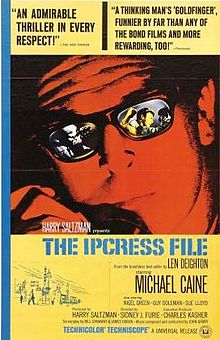
Starring a very young Michael Caine as Harry Palmer, in the second of three film's he completed between 1964 and 1966 which made him an international star, the others being Zulu and Alfie. Palmer is very much not James Bond,  and this is outlined in the opening scenes as he struggles from bed, puts on his glasses and needs a strong cup of coffee before he can take on the day. He is in short an average male. The strength of Caine's performance is to give the character a barely concealed insolence and anti-authoritarian attitude which leads the audience to take his side. Caine's Palmer is reserved and elegant with a passion for cooking and music but with a cockney accent that indicates his working class roots.
The plot centres on the disappearance of a number of British scientists, as Palmer's superior puts it without irony, "a brain drain". Palmer is assigned by the head of his intelligence unit, Colonel Ross to work on the case  for Major Dalby. The latest scientist to go missing, a Dr. Radcliffe had in his possession a file which must be retrieved. Palmer is soon on the trail of an Albanian emigre who deals in kidnapped scientists. It becomes apparent that the scientists are being brainwashed and all is not as it seems. Palmer attempts to make a bargain for the missing Dr. Radcliffe but his superiors appear to be dealing behind his back and Harry is captured by the enemy. He has to escape and out the traitor who sold him out.
The brainwashing aside, this feels like a more realistic portrayal of cold war espionage then the usual suspects.  Harry Palmer is a workaday spy with no real interest in spying and makes for a compelling and endearing character. While not a patch on Alec Guinness portrayal of George Smiley in the BBC adaptation of Le Carre's Tinker Tailor Soldier Spy, this is entertaining stuff. Caine is always watchable and director Sydney Furie makes good use of the cinematography to produce a pretty film, capturing 60's  London at its best.


Palmer: The fellow whose job I'm taking, will he show me the ropes? 
Major Dalby: Maybe - if you're in touch with the spirit world. 
Palmer: I beg your pardon? 
Major Dalby: He was shot this morning. 

All in all, not a bad yarn with a great performance from Michael Caine, showing why he became a star. Produced by Bond producer Harry Saltzman and with a score by John Barry, this is well worth a look.