Showing posts with label tim robbins. Show all posts

Thursday, May 30, 2013

Flick of The Day: The Shawshank Redemption

In August 1982, Stephen King released his new book. It was something of a portmanteau novel combining four separate novellas under the title Different Seasons, linking each with reference to the changing seasons.  One of the novellas was a little fable called “Rita Hayworth and Shawshank Redemption”. So was born a tale of hope and its redemptive power. In 1987, an aspiring young film-maker and screenwriter named Frank Darabont optioned the rights to make the story into a feature film for the princely sum of $1. He had impressed the novelist with a previous adaptation and the pair had maintained a pen pal relationship over the years.  This was to say the least something of a coup for Darabont. The director Rob Reiner has been desperate to acquire the rights to Shawshank having offered $2.5m in the hope of writing and directing his own adaptation to have starred Tom Cruise as the main protagonist Andy Dufresne and Harrison Ford as his friend Red. However Darabont had his own vision for the film and saw it as his opportunity to make something special. Thankfully for all of us, he got to realise his vision.

In Portland, Maine in 1947, a wealthy young banker named Andy Dufresne, played with a Scarecrow in The Wizard of Oz like charm by Tim Robbins, is accused of murdering his adulterous wife. She had left him for a local golf pro and the pair of lovers had been found murdered the next morning. Andy protests his innocence; he went to the house on the night in question and sat in his car drinking with a loaded weapon which he later claims to have thrown in the river.  He is found guilty and sentenced to two consecutive life sentences to be served at Shawshank State Penitentiary. We soon learn that Shawshank is a violent and brutal place overseen by the corrupt religious ideologue Warden Norton, a fantastic career best performance from Bob Gunton, and the thoroughly evil Captain Byron Hadley, played by Clancy Brown. Andy’s quiet and aloof manner is taken by his fellow prisoners as an indication that he sees himself as a cut above. It is not until a couple of months of passed that he speaks a word to anyone.  The man he chooses is Red, a prisoner who knows how to get things. Whatever you require, Red will provide. Morgan Freeman delivers perhaps his greatest performance as Red imbuing the character with wit and charm while retaining a hard edged outlook on prison life borne of his own life sentence.  Andy asks Red to procure a rock hammer; he was a collector of rocks in his former life and wishes to do so again. He later asks Red to procure him a poster of Rita Hayworth. As the year pass by, the pair develop a friendship, something to hold onto against the bleak landscape of the prison. Andy is targeted by a gang of rapists, the Sisters, led by the malevolent Boggs. He is repeatedly attacked, sometimes fighting them off, sometimes not. 

Eventually Andy manages to find himself useful in aiding the corruption at the heart of Shawshank and in particular Warden Norton. Years pass and we find ourselves moving through the 1950s and 60s. Andy is put in charge of the prison library and freed once and for all from the attentions of the Sisters. Throughout the decades of drudgery and setbacks, Andy maintains the hope of eventual freedom. Red on the other hand comes to accept that he may never leave the prison. As we reach a thrilling and life affirming ending, we are left in n doubt that hope can overcome all and bring redemption to those who have long given up on it.

I am determined to keep as much of the plot under wraps as I can for those unlikely few who have yet to see the film as it is such a joy to behold. Andy overcomes so much and yet maintains a lifelong friendship with Red. It would destroy lesser men and indeed the film certainly hints that Andy has taken all that he can take.
There are too many superlatives which could be applied to the film so I will only offer up a few small thoughts. The nuance and exactitude of Darabont’s storytelling is something to behold. There are no moments of fat on the script, it is tight, well thought out and leads to the finest of denouement. In terms of performances, the film is replete with some really fine turns. Tim Robbins perfectly captures a vulnerable and quiet man who is thrust into hell but hopes to retain his human dignity. He seeks only peace where others might need revenge. Morgan Freeman is equally adept as Red or Ellis Redding to give him his full name. He manages to bring a sense of loss to the character. A man who knows that but for one stupid mistake as a young man he could have lived his life. It is this sense of loss which drives him to survive and not rely on superfluous (in his mind) things like hope.

Of course every hero needs an enemy and in Bob Gunton’s Warden Norton, Andy has one for the ages.  From the first moment we meet him, he is a steely eyed zealot determined to enforce absolute rule on the prisoners. Much like Jesuit missionaries or the crusaders of old, he cannot be reasoned with and has a quote from the scriptures to justify all eventualities. Yet he is a deeply immoral man, through the use of Andy’s skills he creates a vast network of corruption with ill-gotten money flowing toward him.
Ultimately the central theme of the film is justice or the lack thereof. Andy may find redemption but he never gets justice. Neither his wife nor her lover could be said to have received it either, their true murderer remaining unaccounted for.  Warden Norton uses his own method to avoid the long reach of justice. I suppose the heart of the film is that you can’t rely on outside forces to deliver you safely; it is only true personal determination that we can hope to survive.

Having watched the film again for the purposes of this, it is strange to think that it was a commercial failure on its initial release, earning a grand total of $16m before it left cinemas.  It was however well received by critics and went on to garner seven nominations at the Academy Awards, including Best Picture. It was only when it reached the home video market that it truly began to be seen by cineastes as the triumph it is. In the years since, the legend has grown to the stage where it is now Number 1 on the IMDB 250 and appears unlikely to be toppled any time soon. It has become something of a Western cultural touch stone which everyone sees at some point. For that alone, I think Stephen King got his $1 worth.

Tuesday, August 9, 2011

Flick of The Day: High Fidelity

Adapting a classic novel for the screen is a difficult proposition. If you swerve too far from the source material, you alienate the core fanbase. On the other hand, if you are too slavish to the material, the film doesn't stand on its own two feet as a work of art. There is of course a happy medium and today's flick of the day, High Fidelity, is a pitch perfect adaptation of Nick Hornby's wonderful novel.
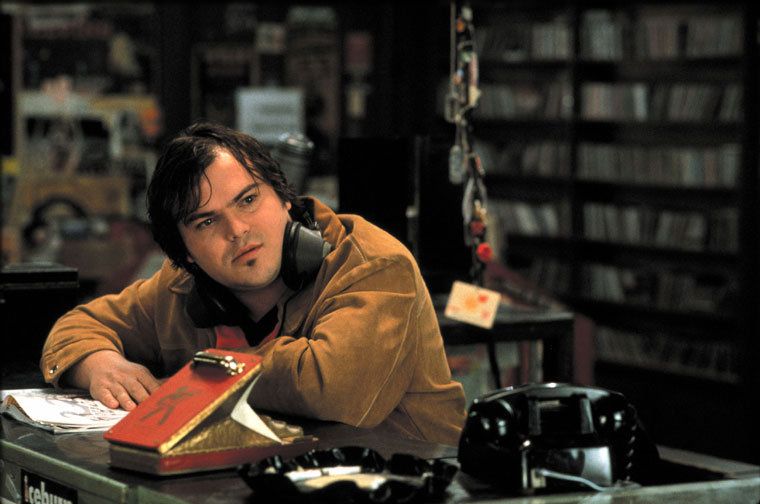
Rob, played by the terribly likeable John Cusack, is breaking up with his girlfriend Laura. He begins to think back through his relationship failures over the years, in the hope of gaining insight as to why Laura left him. While he works through these in flashbacks, Rob expands on his life as the owner of a poorly located record shop, Championship Vinyl, where Rob and his oddball staff played by the brilliant Jack Black and Todd Louiso spend their days talking music, compiling top 5 lists and generally treating their customers poorly. Rob comes to realize that each of his failed relationships had a different cause and that he isn't doomed to be dumped. Ultimately Laura wants more from the relationship then Ron had been prepared  to give and to Rob's horror moves in with uber-annoying hippie Ian, a wonderfully over the top performance from Tim Robbins. Can Ron and Laura work it out?
This really isn't your standard rom-com about a man with relationship trouble who happens to own a record store. It is so much more. It is a film about people who put popular culture at the centre of their lives to the detriment of everything else. Rob's problem is that he still lives like a teenage boy, obsessed with music. It is very true to the source novel, despite shifting the action to Cusack's native Chicago. You don't have to a music snob to enjoy the film but there are plenty of in jokes to satisfy the trendy obscurists. The Beta Band sales drive is a personal favourite and overall there is a lot of humour. Jack Black makes the most of his turn as the obnoxious Barry, capturing perfectly the character Hornby wrote.

                                              Barry's Customer: Hi, do you have the song "I Just Called To Say I Love  You?" It's for my daughter's birthday. 
Barry: Yea we have it. 
Barry's Customer: Great, Great, can I have it? 
Barry: No, no, you can't. 
Barry's Customer: Why not? 
Barry: Well, it's sentimental tacky crap. Do we look like the kind of store that sells I Just Called to Say I Love You? Go to the mall.

Stephen Frears is of course an old hand at this kind of thing, having adapted two of Roddy Doyle's Barrytown trilogy for the screen amongst other things. In short there is much to enjoy here.
The film, of course, is possessed of a great soundtrack with literally hundreds of songs and snippets of songs slipped into the film. It illustrates Rob and his friends obsession and carries the film along nicely.

Rob: I can see now I never really committed to Laura. I always had one foot out the door, and that prevented me from doing a lot of things, like thinking about my future and... I guess it made more sense to commit to nothing, keep my options open. And that's suicide. By tiny, tiny increments.

All in all, a great film adaptation of a classic novel. Of course the novel is still more enjoyable and better somehow but this is as fine an adaptation as I have seen in awhile. The script and the characterisations are perfect. Cusack excels as the man-child, while Jack Black plays the ignorant clown better then anyone else. If you haven't seen it, check it out.

Sunday, May 8, 2011

Flick of The Day: The Player

Of all the talented directors to make their name in the rush to modernity that was 1960's and 70's cinema, perhaps the one most willing to go against the grain was Robert Altman. After a substantial career in television and documentaries stretching back to the late '40s, he made his name with 1969's M*A*S*H which got him recognised as major talent at the same time as a band of much younger filmmakers like Friedkin, Coppolla, and Scorsese broke through. Always one to buck against the system, he was more loved by critics then by audiences and after the failure of his adaptation of Popeye in 1980, he largely disappeared from the Hollywood mainstream and by the time of today's flick of the day in 1992, The Player, he had not made a studio picture in 8 years.
A biting satire of the Hollywood system and the ethics of the film industry in general, The Player is Altman biting back at the hand that fed him. Remembered mainly for its legions of cameos from some of the biggest name in Hollywood, the film centres on a studio executive called Griffin Mill, played by a delightfully slimy Tim Robbins. Mill is receiving death threats from a disgruntled writer for whom he has committed the grievous sin of promising to call him back and never doing so. As the threats escalate, Mill decides to take things into his own hands and try and find out who the mystery writer is he has irked, there are so many possibilities. Another threat to Mill's comfortable lifestyle is the rising star executive, Larry Levy, who Griffin will have to outmanoeuvre to stay at the top. Eventually Mill tracks down a writer in Pasadena who he suspects of holding a grudge. He attempts to buy off the writer with a promise of deal, but of course he has the wrong writer. They quarrel in a car park and in a rage, Mill murders him and flees the scene. As Mill attempts to avoid the suspicions of the local police led by Whoopi Goldberg, he is also attempting to rid himself of his rival Levy by landing him with a terrible movie idea from writer Richard E Grant in a brilliant turn. He is also pursuing the dead writer's girlfriend. Ultimately, events lead to a brilliantly scabrous conclusions as Griffin Mill outdoes everyone.
Altman manages to both skewer Hollywood and endear himself to the insiders judging by the legion of actors, writers and directors that lined up to make cameos in the film including A-listers like Bruce Willis and Julia Roberts. Half the fun of the film is spotting the various people who pop in and out of the rich canvas Altman creates. The film is a vicious attack on all the calling cards of the Hollywood system; Violence, Sex, Mean Spirited Humour and Happy Endings. Yet it mocks them all by containing plenty of each with a happy ending that benefits the wrong man and ironically was a big commercial success accordingly.

Griffin Mill: It lacked certain elements that we need to market a film successfully. 
June: What elements? 
Griffin Mill: Suspense, laughter, violence. Hope, heart, nudity, sex. Happy endings. Mainly happy endings. 
June: What about reality?

It helps of course that the characterizations are so knowingly well drawn. Tim Robbins manages to be just as slimy as you imagine the average studio executive to be. The various celebrities play up to their image as either airheads or having equal contempt for the likes of Griffin Mill as the audience does. 
Altman has created a fantastic film here, managing to both entertaining and a biting attack on the Hollywood system which he had grown to detest after years of watching his films butchered before release. Tim Robbins carries the film completely as an amoral cad bent on power at all costs. It is also technically strong, with an opening sequence shot lasting nearly 8 minutes without a single camera break in a homage to Welles' Touch of Evil and Hitchcock's Rope, which are both referenced by characters in that scene. A very fine film which reminded audiences of the natural talent of Robert Altman. Well worth seeking out.

Wednesday, December 8, 2010

Flick of The Day: AntiTrust

There are some films that are worth seeing because they define greatness, they are the peak of the art form: Citizen Kane, Laurence of Arabia, etc. Then there are films that are worth seeing simply for the enjoyment of the genre be it thrillers or action pictures. Then there is that third category, films that by any measure are poor: badly scripted, irregularly acted, or perhaps laughable special effects but have something compelling about the story or the performance that makes it entertaining. 

Antitrust is just such a film. The setup is thus: Milo Hoffman, a confused looking Ryan Phillipe, is an idealistic young programmer who joins Gary Winston's NURV Corp (Never Underestimate Radical Vision). Winston is Tim Robbins doing his best impression of Bill Gates. Well, an evil Bill Gates, if such a thing existed. The real joy of this film is how completely over the top Robbins' performance is. Of course, as you've already guessed, all is not well at NURV, though I think even the most paranoid viewer won't how imagine how outlandishly bad NURV is.

Look out for the hidden surveillance centre camouflaged as...a day car centre. The tale told for all its faults is compelling enough and you may find yourself cheering at the ending, its just the poor script that lets this film down, take for instance this jargon heavy exchange:

Gary: We've loaded a back door to receive SYNAPSE transmissions on all of our OS software for the past 6 years. We've developed compression schemes and file formats that achieve conductivity, but.. We have a problem. You know what that problem is?
Milo: Ah, your adaptors can't overcome the band width limitation of wireless hand helds 
Gary:That's right

It's not all like this of course but it would help if Ryan Phillipe looked like he understood half the words coming from his mouth.
All in all, worth a look if you have an otherwise empty evening in front of yourself.