Showing posts with label music. Show all posts

Tuesday, April 16, 2013

Flick of the Day: Good Vibrations

 It can often be the case that history on screen can feel somewhat remote and detached from modern life, sometimes the frame of reference can be so different that it is difficult to take in the historical events playing out on screen. This is not always the case; the events depicted in Schindler’s List are as harrowing today as they no doubt were at the time.  For me, the events and happenings in Belfast during the Troubles of the 1970’s and 80’s can feel somewhat remote when played out on screen  given the long period of peace the people of Northern Ireland have enjoyed since the signing of the Good Friday Agreement in 1998. Today’s flick of the day however, Good Vibrations, manages to bring to life the difficult and often harrowing events of those times while also immersing us in the Belfast punk music scene through this fine tale of the life and times of Terri Hooley.

At the opening of the film we are introduced to a young Terri playing in his front garden where all is right with the world until after an exchange of words with some local children he gets a toy arrow to the face and requires a glass eye. At this point, I was slightly worried that the film might turn out to be a tad too grim to be enjoyable but it isn't the case. We fast forward in a bravura sequence of carefully edited news footage to Belfast in the 1970’s. Terri is a music fan and he saw all the greats come to Belfast in the 1960’s : Dylan, the Stones, Jimi Hendrix, the list goes on until of course they stopped coming because nobody went out at night anymore.

We find Terri, played by the excellent Richard Dormer, scratching out a living in Dylan Moran’s dive bar where he acts a DJ to an empty room.  There he meets Ruth played by an equally excellent Jodie Whittaker; he explains that once upon a time he had lots of friends, both Protestant and Catholic and that once the troubles started, they fell into opposing groups with Terri alone in the middle. We see how his former friends now despise him for not siding with either side. After marrying Ruth, they try and form a life together despite the maelstrom which is erupting around them.  However after Terri is the subject of an attempted kidnapping at gunpoint while walking home one night, he decides that he had to do something to foster peace and hits on the idea of a record shop. With the help of Ruth’s idealistic group of friends and a mortgage on his house, Terri sets up Good Vibrations. The story would have ended there but for the fact that Terri becomes drawn into, almost by accident, the emerging punk scene in Belfast. Despite being older than the young people that are the focus of this movement, Terri finds himself drawn to the energy of the music and a scene which is truly cross-cultural and without the infection of sectarianism. He sets out to try and bring as much press and airplay to the burgeoning scene and its various bands including most famously The Undertones and their anthem “Teenage Kicks”.
The real strength of this film is how it perfectly captures the raw energy and emotion of the punk movement and how influential it would prove despite its short initial lifespan.  Yet the film does not ignore the fact that punk was not the only game in town. In a poignant scene, Terri notes how talented musicians from the oft-maligned show band circuit kept the Belfast music scene alive.

The film displays a light touch with a period of Northern Ireland’s history which was grim to say the least and is to be commended for this. The casting of some of the young bands feels spot on, in particular Fergal Sharky of The Undertones. Ultimately the rise and fall of punk in Belfast did not bring about a sea change in relations between the two factions and it can’t be ignored that the Troubles thundered on for another 15 years with perhaps the darkest days in the 1980’s. Yet this film feels like a celebration of a time and place when change felt possible and one can’t help but be caught up in Terri Hooley’s story. As the man himself puts in the end: “When it comes to punk, New York may have the haircuts, London may have the trousers but Belfast has the reason”.


Wednesday, May 2, 2012

Flick of The Day: Once

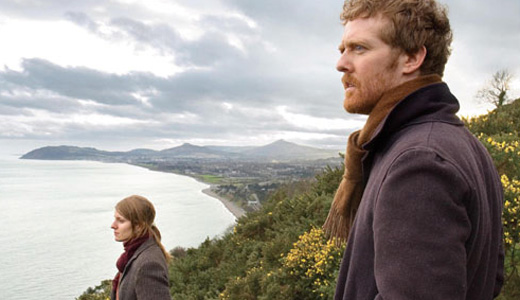
With the news earlier this week that the Broadway adaptation of John Carney's Once had been nominated for 11 Tony Awards, it felt like just the right time to revisit the original film which garnered such praise and a richly deserved Oscar win for Glen Hansard's music. Shot on a budget of €150,000 and financed by the Irish Film Board, it is a romantic tale of music and the bonds it forms between people and perhaps more than that a time capsule of Dublin at the height of the Celtic tiger boom.
A Dublin busker player by Hansard splits his time between helping out in his father's vacuum repair shop and practising and playing his own songs on Grafton street. One day he meets a young immigrant played by Marketa Irglova who makes her living selling flowers and cleaning houses. She quizzes him about his songs and who he wrote them for and he offers to fix her broken vacuum cleaner. Before long we learn that our guy had his heart broken by his ex-girlfriend and has lived with his father since the death of his mother the previous year. The girl is separated from her Czech husband and lives with her young daughter and mother in a small flat in Mountjoy Square on the city's north side. They bond through their love of music and the girl urges the guy to take his music to a wider audience. A small simple tale of the once in a lifetime meeting between two people who catch each other at just the right time.
There is an almost fairytale quality to this film telling as it does the tale of off chance meeting between two unnamed people on the streets of Ireland's capital. John Carney's sparse script is a love story that doesn't rely on the usual tropes of the genre but rather builds itself around the song writing ability of Glen Hansard. This is an inspired decision for Hansard is one of the most talented and least appreciated Irish songwriters of the last 20 years. It is criminal that he has not had the critical success of his contemporaries and yet perhaps this is his just desserts. Once brought his work to a much wider audience, earned him an Academy Award with Marketa Irglova and opened up a world of opportunities including opening for Eddie Vedder on his current tour.
It is six years since the film was shot on a shoestring over the course of 19 days in Dublin and even in that limited timespan, this feels like a timepiece. Shot at the height of the boom years when the sight of new immigrants coming to Dublin was a common one, the direction of migration has very much reversed with the downturn. Despite the fact that neither Hansard and Irglova are trained actors, they deliver believable and measured performances throughout, inhabiting roles that are made for them.
This really is a gem of a movie. It is simple, sweet and and to the point and delivers a memorable tale of romance in modern times while the musicianship of Hansard and Irglova carry the film over the line. A musical for people who don't like musicals.


Sunday, April 15, 2012

Flick of The Day: Walk the Line

Musical biographies are a tricky business at the best of times. Focus too much on the mythology of your average rock star and you end up with something endlessly turgid like Oliver Stone's The Doors and even when you are possessed with a good script, the film can hang solely on the performance of your leading actor. If he or she fails to capture the essence of a much loved loved star then the backlash can leave your film stillborn. Perhaps this is the reason for Martin Scorsese's long gestating Sinatra biopic failing to make it to the big screen as of yet. In any case, in terms of capturing a man and his career albeit only in snapshots then few have come close to 2005's Walk the Line which tells the life of country music legend Johnny Cash.
Opening with Cash, played by Joaquin Phoenix, at the height of his fame and preparing to take the stage for his seminal Folsom Prison concert, we are soon in flashback mode for the rest of the film. We see Cash as a poverty stricken child toiling with his older brother in the fields under the eyes of their stern father, played by a man who has built a second career playing stern characters, Robert Patrick. Perhaps the defining event of his childhood is the death of his brother in a farm accident which his father blames him for. So far, so ho-hum and it is only when Phoenix arrives and screen that the film gets going. His taciturn take on Cash is spellbinding and holds the screen for the remainder of the film. Director James Mangold chooses to focus on Cash's rapid rise in the American country scene from recording for Sun Records to meeting Bob Dylan while chronicling his long term pursuit of his soul mate June Carter. Carter is given a witty souther charm by Reese Witherspoon and the chemistry with Phoenix works well. Both actors give all their own musical performances and the film is all the better for it.
Based on Cash's own autobiographies, the film doesn't shy away from portraying Cash as the flawed individual he was particularly focusing on the lost years of drug abuse and his poor treatment of his first wife. For all this, Joaquin Phoenix gives a measured and charismatic performance as Cash. He is perhaps the coolest character ever to populate the country music genre and consequently his fame transcends this.

Johnny Cash: [playing for the inmates at Folsom prison] Once in El Paso, I had this bag of... Oh... you heard about that? You been in El Paso, too? Well, anyways, I felt tough, you know?. Like I'd seen a thing or two, you know? Well, that was till a moment ago... 'cuz I got to tell you, my hat's off to you now, 'cuz I ain't never had to drink this yellow water you got here at Folsom!
Perhaps the strongest suit of the film is the decision to focus only on a small part of Cash's life concluding with the Folsom concert in 1968, something which really brought Cash to the mainstream. Taking on too much can lead to an over-long and under-detailed mess.
So that's that really, this is a well made biopic of a musical icon with a decent if not too cluttered script and fine performances from the leads. You don't have to be a lover of Cash's music to enjoy the film because there is much here to enjoy for the beginner. Both Joaquin Phoenix and Reese Witherspoon would go on to Oscar nominations for their performances with Witherspoon carrying home the gong.

Monday, November 14, 2011

Flick of The Day: George Harrison Living in the Material World

The Beatles are one of the cultural touchstones of the 20th Century and their story has been told many times across numerous formats. It is refreshing then for director Martin Scorsese to look at this in a different light by examining the life and times of perhaps the most interesting member of the group, George Harrison in his new documentary Living in the Material World, which is today's flick of the day.
Music, and particularly that which he enjoyed in the 60's and 70's has long been an important part of the work of Martin Scorsese. There is an obvious love there for his favourite artists which comes through in his use of music. This passion is put to good use in this enjoyable and in depth look at George Harrison's life. It opens with his youth in Liverpool, a warm and loving family upon which he built his life. Moving on to his life with the Beatles, we see in depth how it shaped him as a man. Each of The Beatles look impossibly young at the beginning and haggard by the end, perhaps a metaphor for their time together. It becomes apparent that it was but a small part of Harrison's life. For his part, he set out to live his life in a spiritual manner and his life after The Beatles was at the heart of this. Scorsese is at pains to emphasise this aspect of his life and it shines through as the strongest aspect of the film. 
If Harrison had a credo, it was to live life to the fullest and just the once. He would probably have no time at all for people sitting around dissecting his every decision. However, this is the level of depth the documentary goes into without really giving us great insight. There is a wealth of footage, and any fan will find much to enjoy as each major event is well documented and ultimately what you are left with is a portrait of a man who lived life to the full, made the best of his gifts and was rich in friends. The number of people who speak of their love for George is an incredible cross section of talented individuals. From Eric Clapton to The Pythons to Jackie Stewart, he seemed to attract people from all walks of life.
All in all, this is a worthy look at an interesting man and if the picture has a flaw, it is that despite all of the footage and the interviews and an obvious attempt to examine his spirituality, you aren't left with a complete portrait. Yet it comes in at over 3 hours and 20 minutes running time, leaving you with a feeling that focusing on less in more detail might have created a fuller portrait of the man. That said, there is much here to enjoy and Scorsese seems to really care about Harrison, rarely is their a negative word about the man. We never really examine his heavy drug use post The Beatles and rarely are events stitched together with the kind of cogency required of great documentaries. However, it is fascinating all the same and well worth a look.

Monday, October 3, 2011

Flick of The Day: Some Kind of Monster

Music documentaries can be a bland affair. So many of the recent offerings feel more like extended promotions for the artist involved with very few getting to the heart of the creative process or of the artists career. This is largely due to the fact that modern artists are smart enough or indeed their management are smart enough to ensure that they are not see in their true guise,  no matter how childishly egotistic it may be. Gone are the days of watching Mick Jagger standing very still as the violence erupts around him at Altamount in the Maysles brothers Gimme Shelter or the gradual unravelling of Bob Dylan: Folk Hero in D.A Pennebaker's Don't Look Back. It is a delight then to announce that American metal band Metallica are just about gormless enough to allow the camera's access to their inner workings during a particularly difficult period. For comedy value alone, today's flick of the day is Some Kind of Monster.
In 2001, American rock band Metallica who have sold 90 million records in their 30 year career found themselves at a crossroads. Their long time bass player had quit the group just as they were to start recording their first new album in 3 years and the camera crew follow them for the next two years as they struggle to get along with each other and record an album. Their management bring in therapist to help them deal with each other at a cost of $40,000 a month, with ridiculous consequences. The lead singer, James Hetfield checks himself into a rehab clinic and his bandmates do not see him for the best part of a year. The drummer, Lars Ulrich leads an ill judged campaign against internet file sharing. All the while they bicker like children and reveal themselves to be extremely self centred and controlling. Oh, yes and eventually they record a so-so album sans guitar solos and recruit a new bass player. 
The most compelling aspect of the film is how unintentionally revealing the band are of themselves. Ulrich comes across as deeply self absorbed and somebody who enjoys the wealth his music gives him as much as anything else despite his attempts to position himself otherwise. There is one scene in particular where he plays the new album for his father who rubbishes it and their relationship is particularly revealing. He struggles to get along with his lead singer at one point launching into a rant about how controlling he is before getting nose to nose and screaming "Fuck!". Hetfield is sombre throughout yet deeply controlling. Upon his return from rehab, the group switch to a noon to 4pm work schedule to allow him time with his children however Hetfield decrees that nobody else may review his vocal recordings after he leaves. All the while, the guitarist, Kirk Hammett remains quiet and only once does he burst forth to complain that the other two do not listen to him.
This aside, the band often come across as completely ridiculous. Some scenes would be fit for This Is Spinal Tap. There is one scene in which they decide that nobody is allowed  to comment on what anybody else is working on and their round table lyrics writing sessions would leave you with the impression that the creative process is not what it once was, with some laughably bad writing. My personal favourite is the scene where they are required to record a promo for a national radio competition by their management which they feel is beneath them, asking would Bono and The Edge do it before proceeding to take the piss out of it.


                                            [Metallica is asked to record a radio promo] 
                          Lars Ulrich: Hey it's Lars from Metallica. I'm about to stick 50 grand up your ass... 
                                            James Hetfield: ...One dollar at a time.

If the band do not cover themselves in glory then their therapist, Phil makes himself look very foolish indeed. Sporting a bizarre choice in knitwear, he spouts inane babble and seems determined to keep them in therapy despite their requests to cease. Whether they actually learn anything about themselves is a moot point.
All in all, a compelling way to spend a couple of spare hours, whether you are a fan of Metallica and their music or not. It is great psychological drama and would be compelling if they were learning impaired garbage collectors rather then wealthy musicians. 

Tuesday, August 9, 2011

Flick of The Day: High Fidelity

Adapting a classic novel for the screen is a difficult proposition. If you swerve too far from the source material, you alienate the core fanbase. On the other hand, if you are too slavish to the material, the film doesn't stand on its own two feet as a work of art. There is of course a happy medium and today's flick of the day, High Fidelity, is a pitch perfect adaptation of Nick Hornby's wonderful novel.
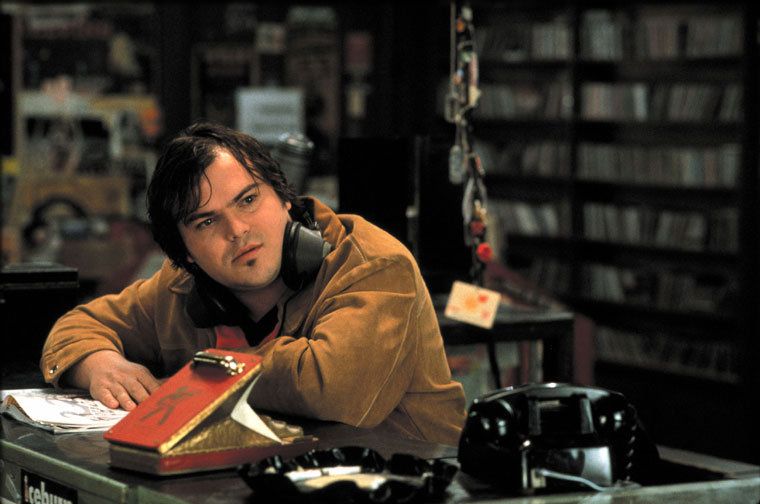
Rob, played by the terribly likeable John Cusack, is breaking up with his girlfriend Laura. He begins to think back through his relationship failures over the years, in the hope of gaining insight as to why Laura left him. While he works through these in flashbacks, Rob expands on his life as the owner of a poorly located record shop, Championship Vinyl, where Rob and his oddball staff played by the brilliant Jack Black and Todd Louiso spend their days talking music, compiling top 5 lists and generally treating their customers poorly. Rob comes to realize that each of his failed relationships had a different cause and that he isn't doomed to be dumped. Ultimately Laura wants more from the relationship then Ron had been prepared  to give and to Rob's horror moves in with uber-annoying hippie Ian, a wonderfully over the top performance from Tim Robbins. Can Ron and Laura work it out?
This really isn't your standard rom-com about a man with relationship trouble who happens to own a record store. It is so much more. It is a film about people who put popular culture at the centre of their lives to the detriment of everything else. Rob's problem is that he still lives like a teenage boy, obsessed with music. It is very true to the source novel, despite shifting the action to Cusack's native Chicago. You don't have to a music snob to enjoy the film but there are plenty of in jokes to satisfy the trendy obscurists. The Beta Band sales drive is a personal favourite and overall there is a lot of humour. Jack Black makes the most of his turn as the obnoxious Barry, capturing perfectly the character Hornby wrote.

                                              Barry's Customer: Hi, do you have the song "I Just Called To Say I Love  You?" It's for my daughter's birthday. 
Barry: Yea we have it. 
Barry's Customer: Great, Great, can I have it? 
Barry: No, no, you can't. 
Barry's Customer: Why not? 
Barry: Well, it's sentimental tacky crap. Do we look like the kind of store that sells I Just Called to Say I Love You? Go to the mall.

Stephen Frears is of course an old hand at this kind of thing, having adapted two of Roddy Doyle's Barrytown trilogy for the screen amongst other things. In short there is much to enjoy here.
The film, of course, is possessed of a great soundtrack with literally hundreds of songs and snippets of songs slipped into the film. It illustrates Rob and his friends obsession and carries the film along nicely.

Rob: I can see now I never really committed to Laura. I always had one foot out the door, and that prevented me from doing a lot of things, like thinking about my future and... I guess it made more sense to commit to nothing, keep my options open. And that's suicide. By tiny, tiny increments.

All in all, a great film adaptation of a classic novel. Of course the novel is still more enjoyable and better somehow but this is as fine an adaptation as I have seen in awhile. The script and the characterisations are perfect. Cusack excels as the man-child, while Jack Black plays the ignorant clown better then anyone else. If you haven't seen it, check it out.

Monday, June 13, 2011

Flick of The Day: The Blues Brothers

I loathe musicals. All that needless singing to advance the plot drives over the edge. There have been legions of Broadway shows that have been adapted for the screen down through the years and I struggle to find a single positive thing  to say. They all seem do overly serious and taken with themselves. However, for a combination of music and performance with a healthy dose of comedy, I must heartily recommend The Blues Brothers as today's flick of the day.
Starring the late great John Belushi and Dan Aykroyd as the eponymous brothers Jake and Elwood, this film is a modern classic from director John Landis. The film opens as Jake is released from prison. Together the two are soon on a "mission from god" in the form of the Nun in charge of their childhood orphanage, which needs $5,000 to stay open. In an attempt to get their band back together and raise the funds, they embark on a madcap cross country trek pursued by State Troopers, Neo Nazis and a murderous Carrie Fisher. Along the way they bump into some legends of blues and soul music including Cab Calloway, James Brown, Aretha Franklin and Ray Charles
The plot is frail to say the least but its carried through by some very energetic musical numbers and by the natural charm of the leading men. John Belushi was never cooler then in this role and it acts as a great reminder of the raw talent that was snuffed out far too young. The other major selling point is the fantastically choreographed car chases with one in particular destroying an entire shopping mall. 

Elwood: Illinois Nazis. 
Jake: I hate Illinois Nazis.

The zany humour at the heart of all John Landis scripts has aged well and any dull moments are forgotten as the film roars to a spectacular finale.
All in all, this is a very enjoyable film which just about carries itself over its 130 minute running time. The various cameo appearances by the great and good of soul and rhythm-and-blues are entertaining and give the film some much needed authenticity. It's funny, lively and one of the few film to come out of Saturday Night Live which has stood the test of time. Well worth a look.

Monday, May 2, 2011

Flick of The Day: 24 Hour Party People

Capturing the zeitgeist and atmosphere of a musical era is a hard task for any film-maker. Many have tried and failed, whether it be through poor impersonations of iconic characters such as John Carpenter's Elvis or the downright tedium of Oliver Stone's The Doors. Perhaps the best attempts have been documentaries, from 1970's Woodstock to 1978's The Last Waltz, there is a rich history of musical documentaries and concert films. It is interesting then to note the approach taken by Michael Winterbottom in today's flick of the day, 24 Hour Party People, documenting the rise and fall of the Manchester music scene from the late '70s to the early 90's. Part documentary, part drama, it is a stunning portrayal of a time and a place.
Narrated by and starring Steve Coogan as Tony Wilson, a television journalist from Manchester, dissatisfied with his job and believing it to be beneath him, he yearns for something more important. In 1976, he attends a concert by the seminal Punk band the Sex Pistols. Although only attended by 42 people, Wilson views this as a historic event as so many of the biggest names in the Manchester music scene were formed by the people at that concert, bands like Joy Division, The Buzzcocks, New Order, and even Mick Hucknall of Simply Red fame. Wilson is inspired to set up his own club night, to give these bands a venue, and ultimately forms a record label, the infamous Factory Records. The films charts the rise and fall of Factory and its music in an irreverent manner, frequently taking liberty with the facts, with Wilson breaking the fourth wall to comment on events as they happen and intercutting the actors with concert footage of the era. Despite having some of the biggest bands of the era, this is a not a tale of money and wealth. If anything, Factory Records is perhaps best remembered for its ability to lose money in the name of art. From the creation of the mammoth Hacienda Nightclub which ultimately brought Wilson's label down to the expensive sleeve for New Order's Blue Monday single which meant they lost money on every copy sold, it is obvious that these were not businessmen but hedonists. 
This is just some of the wonderful detail that give this tale the colour that makes it so interesting. It helps of course that there are so many colourful characters to populate it. There is the depressive genius of Ian Curtis, lead singer with Joy Division, the loutish junkie Shaun Ryder of The Happy Mondays and Wilson himself, always entertaining despite being an overtly pompous character at times and always over the top and bombastic. The film doesn't shy away from the fact that so much of this music scene was drug fuelled, indeed Wilson notes at one point that the reason the Hacienda club lost so much money was that nobody bought drinks, just Ecstasy. 

Tony Wilson: You know, I think that Shaun Ryder is on a par with W.B. Yeats as a poet. 
Yvette: Really? 
Tony Wilson: Absolutely. Totally. 
Yvette: Well, that is amazing, considering everyone else thinks he's a fucking idiot.

Shot with digital video in a restless yet realistic style, Winterbottom succeeds in making drab late 70s Manchester interesting and colourful. Coming in at under 2 hours, the film isn't long enough to begin to grate with Wilson's self deprecating humour carrying the film through its lesser moments. Wilson's conviction  that the likes of the sub-moronic Happy Monday's were poets is undoubtedly a debatable one. This is the point of the film though, Wilson never cared for anyone else's opinion and this comes across throughout the film, he believed all the lines he sells people. 
The end when it comes is quick. Like all great cultural changes, it was over in the blink of an eye. Then the recriminations and hubris begin. However, its the rise and fall that makes this an interesting film and well worth a look. Carried by a strong performance from Coogan and a great supporting cast including Paddy Considine and Andy Serkis, this excellently captures the  Manchester scene.