Showing posts with label michael caine. Show all posts

Tuesday, July 30, 2013

Flick of The Day: Children of Men

I've often thought it funny or at least remarkable that the cinematic vision of the future encountered in so many science fiction films is a dystopian one. Think of the vast cityscape of Blade Runner or the dark streets of Tokyo in Akira or the decaying hedonism of Rian Johnson's recent film Looper, all visions of the future that are a touch nightmarish. It is a rare enough thing to see a film set in the future where everything is better than it is now, perhaps indicative of the natural cynicism of film-makers or indeed of the world we currently live in and the direction of the human race. Suffice as to say today's flick of the day is just as dystopian but in the hands of Alfonso Cuaron becomes so much more than that.
It is the year 2027 and there have been no new human births for 18 years. The human race's hegemony over planet earth is in its final days and the world has descended into chaos. Great Britain remains as a last stalwart against the tide but has become a hellish police state where all immigrants are herded into camps. Clive Owen is Theo, a cynical civil servant and cog in the wheels of the state. Once upon a time he was an activist but has become embittered since the death of his son. He spends his days drinking too much and gambling as a means of passing the time. He visits his ageing hippy friend Jasper, played by an excellent Michael Caine, as a means of getting away from things. He is approached by his former wife Julian, played by Julianne Moore, who has become a member of terrorist group called the Fishes that seek to liberate immigrants with an offer. In return for cash, he agrees to help them transport a young girl to the coast so that she can be picked up by the Human Project, a near mythical scientific group based in the Azores. Of course, all is not as it seems and the young girl holds a secret with the potential to bring redemption to the whole human race. A secret that men will kill for and which Theo will have to risk his life to protect.
There are few bleaker visions of the earth's future than Cuaron's dark stylised take on PD James 1992 book. London is a city filled with despair for the masses but with tiny enclaves of great wealth. In one particularly well executed scene, Theo views the squalor of the city from the safe confines of a Rolls Royce before arriving at the walled splendour of St James Park all set to the tune of King Crimson. This is a London where terrorist bombings are a part of daily life and life itself has become a grim march to the death reminiscent of Orwell's 1984.
The visuals are often stunning and yet unlike so many films set in the future, it doesn't attempt to overreach in terms of the available technology. The cars and computers are slightly better but combined with the grime and dust which covers everything it leaves you with the feeling that man has given up on technology as he enters his final days.
This dark vision could become too much to bear for an audience and the film could become something of trek but yet such is the epic scale of Cuaron's vision that it is never too much. There is enough heart and hope for the redemption of man to carry the film to its thrilling end. It makes for at times affecting viewing and combined with a superb soundtrack that moves seamlessly across genres and decades to pulls at the heartstrings. It is never less than compelling viewing and there are some fine performances even apart from the leads. The great Peter Mullan steals every scene he is in as the deranged immigration officer Syd and Chiwetel Ejiofor excels as the dark hearted ideologue of the Fishes. 
A thought provoking and absorbing tale with a wafer thin premise at the heart of it that remains just believable enough to carry the film. It is an epic journey and perhaps one of the best films of the naughties, if you haven't seen it yet than I urge you to do so.


Sunday, July 22, 2012

Flick of the Day: The Dark Knight Rises

For better or worse, comic book adaptations have largely come to dominate the list of Summer box office titans over the last decade since the release of Sam Raimi's Spider-Man in 2002. This film, an adaptation of perhaps the most commercial of the comic book superheroes spawned two sequels and even a reboot this Summer. Perhaps an unexpected consequence of its success was to set off somewhat of an arms race between the two publishing empires Marvel and DC who have come to dominate the genre. Each Summer since the year of Spidey, there has been at least one major release from the pair. From the awful (Daredevil, Hulk) to the interesting (Iron Man, X-Men), Marvel has been the more dominant of the two with a four year cycle of films culminating in this Summer's tent pole release Avengers Assemble. Perhaps the last laugh may go to DC Comics who have garnered critical acclaim for Christopher Nolan's series of Batman films culminating in today's flick of the day and last in the trilogy, The Dark Knight Rises.
Perhaps the most pleasing element of Nolan's approach to the Batman character has been the intellectual legitimacy which he has garnered for the genre and for his own work. Nolan's Batman is an adult creation who endures in a relentlessly downbeat Gotham, and a world away from the witty quips of an Iron Man or other more child friendly creations. After the success of the previous instalments in the series 2005's Batman Begins and the Heath Ledger dominated The Dark Knight in 2008, hopes were unnaturally high amongst the near-rabid fan base. 
Opening 8 years after the events of the previous film, we find ourselves in a much changed Gotham. Thanks to the Harvey Dent Act, crime has dropped to an all time low under the auspices of Commissioner Gordon, played again by the great Gary Oldman. Meanwhile Bruce Wayne has retired into seclusion, a Howard Hughes like tragic figure who hides in the shadows of his vast mansion while his Batman alter ego has not been seen since the death of Dent at the end of the previous film and has taken the blame accordingly. However there is a storm brewing in the shadows of Gotham, a mysterious cat burglar named Selina Kyle is making herself known. Kyle is played by the surprisingly adept Anne Hathaway. Also stepping into the complacent Gotham is the terrorist Bane played by a bulked up Tom Hardy. Bane is the very antithesis of Bruce Wayne's moral code,a masked man who wishes to see Gotham brought to its very knees and is introduced to us in a spectacular opening scene. The cast is rounded out by the ever reliable Michael Caine reprising his role as Alfred and Joseph Gordon Levitt as a young police officer with an independent streak while Marion Cotillard is underused as a wealthy social campaigner.
Without delving too deeply into the plot, suffice as to say Christian Bale's mournful Bruce Wayne is forced to don the black cape once more to defend the city once more but will he still be up to it or will Bane prove too much for him? The films moves from one stand out scene to another while still managing to detail the moral turmoil at the heart of the tale.
Despite coming in at an ass numbing 2 hours and 45 minutes, the film doesn't seem to lag at least I never felt my mind wandering. There is much to enjoy here from a visual perspective and as with so much of Nolan's best work, there is a subtle subtext at work here. Bane appears to be less the kind of unthinking Lucifer that was Ledger's Joker and more of a crusading villain attempting to return Gotham to its own year zero. There are some interesting references to corrupt bankers and the evils of wealth but they are not fully followed through and merely exist to hang Bane's psyche on.
Again without giving anything away, the ending is an enjoyable piece of storytelling which ties up the looses ends nicely while delivering the kind of emotional punch and what if analysis seen in Nolan's Inception. The wide and varied cast deliver in their respective roles with a special mention for Michael Caine, who as Alfred is the moral core of the film attempting to rein in Bruce's need to satisfy and save. Caine will be 80 next March and is still delivering performances that wow. As noted, Marion Cotillard is largely underdeveloped given her pivotal role in the film though perhaps this was intentional. Nolan's direction is never heavy handed  and hits all the right notes in the set-pieces while the score from Hans Zimmer serves to enhance the action with its terrible Sturm und Drang giving the piece an epic feel. And the film is epic if nothing else, the breadth of the story and the moral complexity of the characters is unlike anything previously attempted in a comic book adaptation. 
While not hitting the heights of perfection which so many fans had unreasonably hoped for, this is a strong ending for Nolan's trilogy and nicely finishes out the tale which began uncertainly in 2005. Bale is undoubtedly the best actor to have taken on the role of Batman and his broody intensity was well matched with Nolan's attempts to take the character down the dark road to which it is best suited. Arguably Nolan's best work has been outside of Batman with Inception and The Illusionist. I look forward to his next work. So then in conclusion, not perfect but a very enjoyable film all the same.

Wednesday, April 13, 2011

Flick of The Day: The Ipcress File

The cold war is the setting for so many thrillers, indeed in the 70's and 80s it was very easy to spot the bad guy in a James Bond movie because he invariably spoke with a Russian accent or rather a classically trained British thespian's idea of a Russian accent. Steven Berkoff anyone? Today's flick of the day, The Ipcress File is a cut above the standard cold war spy thriller, indeed it was originally advertised as "The Thinking Man's Goldfinger".
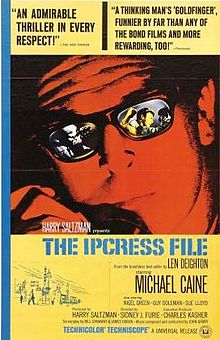
Starring a very young Michael Caine as Harry Palmer, in the second of three film's he completed between 1964 and 1966 which made him an international star, the others being Zulu and Alfie. Palmer is very much not James Bond,  and this is outlined in the opening scenes as he struggles from bed, puts on his glasses and needs a strong cup of coffee before he can take on the day. He is in short an average male. The strength of Caine's performance is to give the character a barely concealed insolence and anti-authoritarian attitude which leads the audience to take his side. Caine's Palmer is reserved and elegant with a passion for cooking and music but with a cockney accent that indicates his working class roots.
The plot centres on the disappearance of a number of British scientists, as Palmer's superior puts it without irony, "a brain drain". Palmer is assigned by the head of his intelligence unit, Colonel Ross to work on the case  for Major Dalby. The latest scientist to go missing, a Dr. Radcliffe had in his possession a file which must be retrieved. Palmer is soon on the trail of an Albanian emigre who deals in kidnapped scientists. It becomes apparent that the scientists are being brainwashed and all is not as it seems. Palmer attempts to make a bargain for the missing Dr. Radcliffe but his superiors appear to be dealing behind his back and Harry is captured by the enemy. He has to escape and out the traitor who sold him out.
The brainwashing aside, this feels like a more realistic portrayal of cold war espionage then the usual suspects.  Harry Palmer is a workaday spy with no real interest in spying and makes for a compelling and endearing character. While not a patch on Alec Guinness portrayal of George Smiley in the BBC adaptation of Le Carre's Tinker Tailor Soldier Spy, this is entertaining stuff. Caine is always watchable and director Sydney Furie makes good use of the cinematography to produce a pretty film, capturing 60's  London at its best.


Palmer: The fellow whose job I'm taking, will he show me the ropes? 
Major Dalby: Maybe - if you're in touch with the spirit world. 
Palmer: I beg your pardon? 
Major Dalby: He was shot this morning. 

All in all, not a bad yarn with a great performance from Michael Caine, showing why he became a star. Produced by Bond producer Harry Saltzman and with a score by John Barry, this is well worth a look.

Tuesday, March 29, 2011

Flick of The Day: Hannah and Her Sisters

Another day, another Woody Allen movie. Last week we looked at Allen's masterpiece Manhattan, his last film of the 1970's. A decade which defined his career and his work in the 1980's was much more sombre in tone and influenced by European directors like Ingmar Bergman. This is not to say that the work was any less entertaining or well made. Some highlights of this period include Radio Days and today's film Hannah and Her Sisters
Hannah and Her Sisters is concerned with the lives and loves of a set of New York bohemians and artistics. The film opens with a Thanksgiving dinner where we are introduced to the main characters. Hannah, ably played by Mia Farrow is an actress, her husband Elliott, in an Oscar winning performance by Michael Caine, lusts after her sister Lee, played by Barbara Hershey who is living with arrogant artist Max Von Sydow. Allen himself appears as a neurotic (Can he play otherwise?) television producer who spends the film convinced he is going to die and ends up dating Hannah's other sister, the eminently irritating Holly, another actress.
The sisters meet on a weekly basis to discuss the week's events, what is most interesting is what they don't tell each other. At various points in the film, they each say how close they are to each other but then lie or misrepresent their lives to each other. The film takes place over the course of three Thanksgiving parties. At the first, all are contented. The second is a time of unhappiness and the third and final party takes place after everything has been resolved. 
The film still has that trademark Woody Allen dialogue and it still sparkles as much as ever but this is perhaps his most complex and rewarding film. There is a great depth to the drama and the relationships of the characters. Indeed, the scope of the film and its tale is almost novelistic. There is a considerable story arc here and as a viewer, there is much to enjoy.

[after learning Mickey is infertile] 
Hannah: Could you have ruined yourself somehow? 
Mickey: How could I ruin myself? 
Hannah: I don't know. Excessive masturbation? 
Mickey: You gonna start knockin' my hobbies?

While none of the characters are particularly endearing and indeed some of them at times grate, they are always compelling. Michael Caine deserves kudos for playing against type as a self centred egotist.

What if there is no God and you only go around once and that's it. Well, ya know, don't you wanna be part of the experience? You know, what the hell it's not all a drag. And I'm thinking to myself, Jeez, I should stop ruining my life searching for answers I'm never gonna get, and just enjoy it while it lasts. And after who knows, I mean maybe there is something, nobody really knows. I know maybe is a very slim reed to hang your whole life on, but that's the best we have. And then I started to sit back, and I actually began to enjoy myself.

Another fine piece of film-making from Allen, well worth your time and putting the effort in for there is much to enjoy in this character study. It is so much more then a comedy. 

Monday, February 14, 2011

Flick of The Day: The Quiet American (2002)

Graham Greene was one of the great writers of literary fiction of the late 20th Century, combining a journalistic eye with a flair for storytelling to great effect. One of his best traits was his prescience, putting his finger on the pulse of the political climate of the day and writing novels that foreshadowed the Communist takeover in Cuba and the American build-up in Vietnam amongst others. This has led to numerous adaptations of his various novels with today's film The Quiet American the second such adaptation of this work.
Retaining the anti-American tone of Greene's novel, this is a very fine adaptation of a classic tale of world weary cynic, Thomas Fowler, a British journalist working for The London Times in Saigon in 1952, covering the gradual downfall of the French occupation and the inexorable rise of the communist forces of North Vietnam. He takes tea at 11 each morning and files the odd story with the London office, spending most of his time romancing his Vietnamese girlfriend Phuong and smoking Opium. Into this scene comes Pyle, ably played by Brendan Fraser, as an idealistic young American in Saigon ostensibly to offer aid to the struggling country. Fowler has an open distaste for the machinations of the American legation but respects Pyle's idealism if not where it ultimately leads.
Michael Caine is excellent as Fowler, playing a character who is struggling with competing motivations that are not always pure. He wants to stay uncommitted from the war which is brewing all around him while still sticking to his principals, all the while trying to retain the love of his girlfriend. It is a delicate performance which carries the film. The film's other main attribute is the realistic portrayal of Saigon, a beautiful French colonial City with a constant smell of damp decay in the air, pervading its squares and cafe's. If there is a criticism, it is that there are no really well fleshed out Vietnamese characters. They all seem to be there to act as metaphors for the Vietnamese peoples national character. 
This film was inirially held back for release by almost a year after 9/11 as it was felt that its tone was out of step with the mood of the day. This is perhaps unfair as It is both true to Greene's intentions ans is not as overtly anti-American as this action would imply. Pyle's actions while well-meaning are reprehensible and they are symptomatic of how America did act in Vietnam, duplicitous and with its own interests at heart, not those of the Vietnamese people. This is a fine film with a nuanced central performance from Caine and a compelling mysterious storyline. Well worth a look.


Sunday, January 30, 2011

Flick of The Day: Blood & Wine

Director Bob Rafelson and Jack Nicholson have had a career long partnership, resulting in two of the best films to come out of the '70s generation, Five Easy Pieces and The King of Marvin Gardens. Rafelson has said that this film, acts an unofficial finale to a trilogy started with the above.
Alex Gates, a dark and increasingly haggard Jack Nicholson, is a well to do wine merchant, whose business and marriage are quickly floundering in the Miami sunshine. His prescription drug addicted wife is resentful and suspicious of where he spends his nights, quite rightly too as it turns out. His step-son, a very young Stephen Dorff, has little but contempt for him. Meanwhile he is plotting with an ageing terminally ill Michael Caine to steal a million dollar diamond from a wealthy client. Add to this maelstrom, Jennifer Lopez as a scheming Cuban immigrant and you have a classic film noir setup.
Caine and Nicholson play well off each other, playing grotesque versions of themselves. Caine is excellent as old con getting more desperate as he gets closer to his reckoning. Nicholson is equally adept as a man reaching the end of his tether, largely due to his own mistakes. If there is one problem with all this, its that none of the characters are particularly likeable, and consequently you don't find yourself rooting for anyone as the double and triple crosses take hold as we head toward a denouement. Only Dorff comes out with any credit, as the strangely sullen son, who has no apparent interest in the wealth the diamond might bring.
Jennifer Lopez, deserves credit for making more of a role that otherwise would have faded into the background. Ultimately the film leads to a dissatisfying ending for all concerned but its interesting all the same, for the interplay between Nicholson & Caine, who have never worked together before. Like all film noir you get dragged into the tale and want to see where it goes, this one doesn't go where you want it.