Showing posts with label french. Show all posts

Wednesday, March 21, 2012

Flick of The Day: La Haine / Hate

Bursting onto the scene in 1995 with today's flick of the day, La Haine, Mathieu Kassovitz was the next big thing in French cinema compared perhaps stupidly in hindsight to Spike Lee. La Haine was a controversial film on it's release dealing as it does with issues of race, violence and the class divide in modern France  and went on to win the Best Director prize at Cannes. This early promise has yielded mixed results at best with the risible Halle Berry vehicle Gothika and the perhaps best forgotten Vin Diesel starring Babylon A.D being the highlights.
La Haine documents a day in the life of three disaffected youths from differing backgrounds in the grim Paris banlieues. Vinz, played by Vincent Cassel perhaps the best French actor of his generation, is Jewish and a hot head spoiling for a fight with the police. Hubert, played by Hubert Kounde is black and a promising boxer who is the opposite of Vinz and tries to preach the path of least resistance. In the middle of these is Said, played by Said Taghmaoui, who spends his time keeping them apart. Jobless and penniless and without prospects of either, they spend their days hanging around the housing estate while at night engaging in skirmishes with the local police. As the film opens, another youth has been seriously injured by police in a riot. With tensions high on the estate and the police at breaking point, a cop loses his weapon in the chaos and it falls into the hands of one of our three  friends. As the day turns into night, we seem set for tragedy on the streets.
Shot in a stark black and white, this is a worryingly relevant film even today. The terminal decline of the Paris banlieues has if anything accelerated and the problems of race and the class system are as divisive as ever. As I write this, the French police are currently attempting to capture a man accused of murdering 6 people of ethnic origins in a hate crime and in the upcoming French elections, immigration will be a focus of attention in a country where the national front routinely wins a quarter of the vote. The use of black and white photography by Kassovitz highlights that the divide is not so much on ethnic grounds as it between the haves and have nots. Vinz, Hubert and Said are a Jew, an African and a Muslim. Not obvious friends if society is to be believed and yet they are joined by their struggles to escape the Paris slums.

Hubert: Heard about the guy who fell off a skyscraper? On his way down past each floor, he kept saying to reassure himself: So far so good... so far so good... so far so good. How you fall doesn't matter. It's how you land!

Kassovitz shows a side of Paris that is not on any tourist trail. The Eiffel tower is glimpsed only in the distance and any interaction with the cultural centre only reinforces the fact that these guys are outsiders.
At the time, La Haine was compared to the early work of Spike Lee in terms of its angry social conscience. Perhaps a better comparison would be to some of the New York films of Martin Scorsese in terms of capturing a Zeitgeist such as Taxi Driver and Bringing out the Dead. While perhaps inspired by these films, it is a work of true originality and at times brutal truth. It avoids the clichés of "honour in the hood" seen in American films such as John Singleton's Boyz N The Hood.
An important film that still has the power to shock even 17 years after its release, La Haine is a must see. It is as Paris as you haven't seen it and is as relevant a portrait of the city today as it was on release. It introduced the world to Vincent Cassel who would go on to be perhaps the biggest star in French cinema today while Hubert Kounde and Said Taghmaoui would build strong careers. Well worth a viewing.

Tuesday, January 10, 2012

Flick of The Day: The Artist

The silent cinema era produced works by artists like Chaplin and Keaton which are still beloved today, still funny today.This is conclusive proof, if it was needed, that great art and entertainment transcends technology and style. Be it the advent of sound, colour, Cinemascope, Technicolour, 3D (the first time), IMAX, digital effects, 3D (again), the basic ingredients of a decent film have remained the same. I was looking forward then to seeing The Artist, the much applauded hit from last year's Cannes festival and a silent film.
In 1927 Hollywood, Jean Dujardin  plays George Valentin, a matinee idol of the silent era just as the industry moves to talking films. While his marriage is far from perfect, he has an adoring public and a pet dog which steals every scene in the film. One day while attending the premier of his latest film, he meets a young chorus girl called Peppy Miller played by the delightful Berenice Bejo and falls for her. As the years pass, the silent era is surpassed by the talkies and Peppy becomes a big star while a scrambling George invests the last of his wealth in another silent picture, unwilling to change with the times. As their paths diverge, George's marriage disintegrates along with his fortune and he finds himself and his canine companion living on the margins. He is even forced to dispense with the services of his loyal chauffeur played by James Cromwell. Peppy however has not forgotten him and seeks him out but not before he tries to burn down in his apartment in a fine action set piece centred around the wonder dog. 
I didn't have any real expectations before viewing this and I can see why the idea of a silent film might turn off the average cinema goer but it would be a real loss as this is a masterful film combining the epic sweep of the silent era with modern humour and technique. It is a joy to watch writer and director Michel Hazanavicius tell a story without the use of dialogue. This is achieved with remarkable ease, marking  this as the work of a gifted film-maker. The silence never feels forced or overbearing and it never detracts from telling the story. The tale itself to me bore strong similarities to the Barbra Streisand version of A Star is Born from 1976 but then that story has been told on screen at least 3 times so far. It is a simple tale of loss and regret with a love story at its core. 
It is this love story which combined with comedic scenes carries the film to its conclusion. It is the kind of film that leaves you with a smile on your face. I couldn't complete this review without mention of the real star of the film, a dog named Uggie who without exaggeration manages to steal almost every scene in the film. He is at the centre of a very well acted set piece when George attempts to burn his house down and Uggie tries to attract help to save him. It is so well done, you will easily forget you are watching a silent film.
All in all, this film is a triumph. It manages to successfully pay homage to the silent era while remaining within the rigid boundaries of the form and telling an entertaining tale. It is funny, dramatic and heartwarming and is fully deserving of any rewards which come its way over the next few months.

Wednesday, November 23, 2011

Flick of The Day: Pater

I have often pondered the cultural divide between nations, particularly when it comes to cinema. It often appears that European cinema is far more cultured and worldly than the standard multiplex fare created in Hollywood but then perhaps that  is just a perception formed by the fact that we tend to only see the higher quality films from Germany, France, South Korea, etc exported to our shores given the costs of subtitling and release. I am sure each of these countries produce plenty of dodgy action and schlock horror flicks. We just never see them. That said, there is undoubtedly a wildly different attitude in cinematic taste from country to country. The less developed a country, the less developed its tastes though this is not a hard and fast rule. Since the dawn of cinema, it was the art form of the poor working classes. Imagery transcends language barriers in immigrant communities so much easier than other forms.
With this in mind, today's flick of the day is Pater, an experimental narrative from France which received an inexplicable 17 minute standing ovation at Cannes and yet will probably never receive a cinematic release outside of France. A matter of national taste surely.
From director Alain Cavalier and actor Vincent Lindon, two doyens of the French avant garde cinema comes this experimental political satire. Over a serious of lunches and meetings over the course of a year, the two men take on two characters and create a narrative around them that is at once compelling and complex. Cavalier becomes the President of France, an ageing politician looking to retire. Lindon is his new Prime Minister. Together they aim to change France forever by instituting a maximum wage in France. As the meetings progress, they become more drawn into their tall tale and the characters they have created, ad libbing conflicts and speeches they will give as they lurch from one policy decision to another. 
While never likely to be a commercial success outside of France, there is an interesting film here. Filming with handheld cameras and playing without a script, this is as much about film making as it a story.  It is interesting to see talented people become drawn into roles they have invented and driven from the beginning. At one point, Lindon acknowledges this, saying that he now walks down the street wondering why the nation doesn't consult him on important matters like his character.
I think it probably says much about France that this film was such a success at Cannes. As a nation, they would seem to have more time for the arcane and the odd then other nationalities I can think of. Alain Cavalier has long forged his own path in French cinema and it is a testament to his talent that he can attract an actor of the calibre of Vincent Lindon to such a non-commercial project. While not to everyone's taste, it stands up as piece of cinema if not as a piece of entertainment.


Monday, July 18, 2011

Flick of The Day: A Prophet / Un Prophete

The prison film is a well travelled genre. There is something about the incarceration of our fellow man that for whatever reason leads to great drama. I suppose as it is unnatural for human beings to be incarcerated, it is then the strongest sentence a society can impose to restrain that natural freedom. This struggle creates drama, plot and ultimately a compelling story. There have been many very fine prison dramas from Cool Hand Luke, to The Shawshank Redemption, one of the all time greats. To this list then must be added today's flick of the day, A Prophet.
A young man of Arabic descent, vulnerable but retaining immense character is immersed into the hellish world of a notorious French prison after receiving a sentence of 6 years for a crime that is never explained in any detail. Malik played by newcomer Tahar Rahim is quickly initiated into brutality of every day prison life.The prison is initially split into two rival groups, the Corsicans led by a violent brute called César Luciani played by  the brilliant Niels Arestrup who hold all the power and the Arabs while growing in number are very much under the boot of the Corsicans. César gives Malik an ultimatum, either he murders a fellow Arab due to testify against a Corsican or he himself will be killed. A torn Malik is pushed into the hit and gradually earns a grudging respect amongst the Corsicans. Before long, he graduates from small time criminal to fully fledged gangster creating his own criminal network on the outside. Eventually he outgrows the machinations of César and becomes his own man.
Directed by Jacques Audiard, this is a triumph of a film on so many levels. Firstly, the performances of young Tahar Rahim and the legendary Niels Arestrup are one of the finest on screen pairings I have seen in many years. The growth of Tahar's character from callow youth to gang leader over the course of two and a half hours of screen time is breathtaking as he comes under the influence of Arestrup's brutish and yet quietly scheming César. Arestrup was previously seen in another French flick of the day, Farewell. Secondly, the film is perfectly paced, written more like a novel then your average film. With each chapter additional layers are added. Central to everything is that Malik is a very compelling character. Shunned by his fellow Arabs for being close to the Corsicans and too Arab to ever be a Corsican, he is in the middle of the prison's gang wars and is smart enough to ultimately play one against the other. Malik is no angel, he is capable of violence but yet compared to the fearsome César is a character you can root for.
A big international upon its release, A Prophet was just pipped to the Best Foreign Language Picture at the 2010 Oscars by the equally brilliant The Secret in Their Eyes. It is well worth another look, it is the kind of film that once again reinforces my opinion that the best film-making in the world today is not in Hollywood but in the rest of the world. A triumph.

Tuesday, May 10, 2011

Flick of The Day: Farewell / L'affaire Farewell

From acclaimed French director Christian Carion comes this beautiful little tale from the depths of the cold war, based on a real life spy story that ended with tragic consequences, today's flick of the day is Farewell.
Sergei Gregoriev is a high ranking KGB analyst in 1981 Moscow, wonderfully played by the Serbian film director Emir Kusturica. Sergei is dissatisfied with the Communist system and the cronyism of its leader Brezhnev and in an attempt to finally take down the regime, he decides to begin leaking information of the most sensitive kind to the West. His contact of choice? A young French businessman working in Moscow, Pierre Froment played by the director Canet. Making contact and gradually befriending Pierre, Sergei passes secrets which Pierre passes to French Intelligence and ultimately to Presidents Francois Mitterand and Ronald Reagan. The secrets were so valuable that it could only be seen at the highest level. Motivated only by ideology, Sergei only asks for some Queen tapes for his rebellious young son and a Sony Walkman. Of course as the stakes get higher, it becomes harder and harder for the two men to remain undetected as they pushed to breaking point. Like all the best espionage tales, this has a thrilling though poignant conclusion and asks questions of the lengths individuals will go for freedom.
The film is highly atmospheric, capturing the look and style of life under the Soviet system in the early 80's with some beautiful camera work of the city. The story it tells is a highly compelling one, so implausible it is amazing to find it a true story. Indeed, it is highly entertaining to see the extent to which the Russians has wormed their way into the heart of the American government. This is not your typical spy movie then, it is much more in the style of a John Le Carre thriller, with a lot of emphasis on the atmospherics and the minute details with less emphasis on action. The ending when it comes is not unexpected though sad all the same.
The regular references to the passing of intelligence between Reagan and Mitterand is useful, it lets you know how big an operation this was. Reagan is ably played by Fred Ward, while their is an icy turn from Willem Dafoe as the Head of the CIA. In reality the actions of Sergei did have the desired effect. His intelligence led to the destruction of the Soviet spy network in the US, and when Reagan announced his "Star Wars" initiative, the Soviets were in the blind and it forced Gorbachev to come to the Reykjavík Summit with no inside information and begin negotiations that eventually culminated in the Intermediate-Range Nuclear Forces Treaty a year later.
A very enjoyable film and an important story at the same time. It was because of the efforts of men like Sergei that the Cold War came to a conclusion, with the threat of Nuclear annihilation no longer hanging over the people of the world. Well worth a look.


Wednesday, May 4, 2011

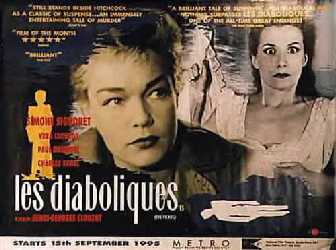
Flick of The Day: Les Diaboliques / The Devils

A few weeks back we looked at Henri-Georges Clouzot's work, The Wages of Fear, noting his reputation as the French Hitchcock. Today's flick of the day is perhaps his masterpiece, Les Diaboliques, a devilish psychological thriller set in a boarding school. 
In a provincial boarding school run by the brutish Michel Delassalle played by Paul Meurisse, his long suffering wife Christina and his equally downtrodden mistress Nicole are plotting murder. Though Christina owns the boarding school of which he is headmaster, she has been beaten down by years of abuse and suffers from a weak heart. Together they draw up a plan to get rid of him over a holiday weekend. Christina runs away with Nicole to her country home and telephones Michel to demand a divorce. Michel pursues the pair and when he arrives, Christina drugs him with tainted whiskey and together they drown him in a bathtub. Hiding the body in a wicker basket, they return to the school late at night and dump Michel into the murky depths of the pool. Of course, like all best laid plans, something goes wrong. A series of events point to Michel being very much alive and when they drain the pool, his body is nowhere to be found.  Is he alive or dead? Christina can not handle the guilt and with her heart troubling her takes to her bed. However all is not as it seems and Les Diaboliques has one of the great twist endings of all time.
This is a real gem of a film and Clouzot successfully builds the tension as the plot unfolds and Christina's mind begins to unravel. He does this by creating a chilling atmosphere in the school, with pupils swearing they saw the missing headmaster and lots of atmospheric dark corners with doors opening unbidden in the night. All very much the kind of tactics used in your average horror film. This leads the audience to begin to question what they are seeing, much like Christina. Until the last frame, you are unsure as to Michel's ultimate fate and that is a remarkable achievement. There is also some some excellent symbolic imagery. When a guilty Christina hires a retired detective to investigate Michel's disappearance, there is a scene where they talk in the bedroom partitioned by bars much like a murder suspect behind bars.
It is difficult to overestimate the significance of this film with its plot lines and twists turning up in various forms in numerous thrillers down through the years. Indeed the film itself has been remade three times including a truly dire Sharon Stone vehicle from the '90s remarkable only for abandoning Clouzot's ending and reproducing the rest of the film shot for shot. I suppose it has always been thus in Hollywood.

Christina Delassalle: So it's a coincidence? 
Nicole Horner: A coincidence, yes. 
Christina Delassalle: And Fichet. Was his being at the morgue a coincidence? And the suit. And the hotel. And now the children! Is it a coincidence that it's getting closer and closer?

A great film which any self-respecting thriller fan has to see, it has become a touchstone for the genre since its release in 1955. Perhaps Clouzot's best work alongside The Wages of Fear, it marked  him as director par excellence. The film still feels fresh today with its plot riddled with turns, sexual intrigue and a story that any audience can find compelling and believable.

Monday, April 11, 2011

Flick of The Day: The Wages of Fear / Le Salaire de la peur

After a decade as a screenwriter, Henri-Georges Clouzot rose to great acclaim as the "French Hitchcock" in the 1940's and 50's. If anything however, his ability to turn the screw in a taut thriller exceeded even the master himself. With film's such as Diabolique and today's flick of the day, The Wages of Fear, Clouzot established himself internationally as a director of thrillers par excellence. 
The film's plot centres on a small group of men who are stuck in a small town in South America for various reasons, a lack of funds being a central theme. The town is a desolate strip in the middle of a barren desert, its only real link to the outside world a small airport. The men cannot afford the airfare and don't have any documents if they could. They are stateless workers, lost in the desert. The only opportunity for employment in the town is to work for an American oil company, SOC who control the town, paying workers a pittance and taking the law into its own hands if necessary. The first half of the film examines the men's daily struggles, largely taking place in the cantina where they spend their days. The four main protagonists are Mario, a Corsican and Jo a fellow Frenchman who together bond over their love of Paris. There is also Bimba, a quiet intense Dutchman and Luigi, a happy go lucky Italian with a strong work ethic. Before long, news reaches the town of a massive fire at one of the oil wells in the desert. The only way to put the fire out is to use nitroglycerine, itself highly explosive. SOC needs four men to transport it across the decidedly treacherous roads as it is considered too dangerous for their employees. Lured by the offer of $2,000 per man, the stateless souls fight to take on the job. So the four men set off into the wilderness. Two trucks packed with nitroglycerine. As the miles pass, the tension mounts, with each twist and turn they risk certain debt.
The film is worth seeing for the extended transport sequence alone. It is so tense, you sit on the edge of your seat, awaiting an explosion to take them all away. Clouzot has filled in the audience on the background of each of the characters, and why they are in the desert, meaning there is a genuine interest in their fate. It is one of the great sequences in cinema. 

"When I was a kid, I used to see men go off on this kind of jobs... and not come back. When they did, they were wrecks. Their hair had turned white and their hands were shaking like palsy! You don't know what fear is. But you'll see. It's catching, it's catching like small pox! And once you get it, it's for life! So long, boys, and good luck."

The oil company are portrayed as the worst kind of American imperialists and this led to a number of scenes being cut from the American release after accusations of anti-Americanism. Something not unfamiliar to Gaullist France. The American's are anti-union and only hire the "bums" as "those bums don't have any union, nor any families. And if they blow up, nobody'll come around bothering me for any contribution".
The film was remade in 1977 by the New-Hollywood wunderkind, William Friedkin, as Sorcerer. The film was a flop for one very obvious reason, it's rather glaringly inappropriate title. Fans of Friedkin's The Exorcist were undoubtedly disappointed not to find a single Sorcerer on display. The original is by far the better of the two film's, anchored by a fine performance from Yves Montand. Is there anybody more quintessentially French then Yves Montand?
One of the best film's to come out of France in the 1950's and possibly Clouzot's best work, it sets the scene with its opening half before heading for a thrilling finale. It is well worth a look.